Feeds:
Posts
Comments

Rating: 4/5

A quick and dirty, Aaron Berdofe branded version of Coq Au Vin (Translated: rooster with wine) made with braised chicken thighs, leeks, yellow onion, golden beets, crimini and oyster mushrooms, shallots, cajun chicken sausage, tomato paste and of course, red wine.

Wine: Charles Smith’s Boom Boom Syrah 2009

Notes:

Most of the time I prefer to buy wine that’s restricted to a particular region.  This generally ensures that the quality will be acceptable.  However, occasionally I break from tradition if the winemaker behind the wine knows a thing or two.  Enter Charles Smith; the guy out of Washington state that makes quirky wines with iconic b&w labels that make hipsters swoon. You might have passed by his Velvet Devil Merlot in the wine shop a few times, but now you’ll be able to spot it as a Charles Smith wine from afar just by the label.  Boom Boom, I believe takes grapes from three different areas in Washington thus giving it a Washington State designation and not say a Walla Walla designation.  Anyway,  I can’t really use the word “explosive” with this wine like every other regurgitated wine review you’ll see on this.  I can however, tell you that the experience you’ll get is much more akin to taking a dose of Pop Rocks in your mouth, sans soda pop of course. This wine bursts at irregular intervals with blackberry, spices, roasted meats and violets which makes you take a moment, let out a sigh and say, “Cool.”  The oak on this wine is nice and smooth which makes me think it was French. In other words, it was a delightful accompaniment to my updated Coq Au Vin.  I really didn’t know what to expect from either of them so the unpredictable-ness of the whole thing just kind of worked out into something warm and fuzzy.  The only reason I didn’t give this a full 5/5 rating was because I had some thoughts on a few other wines that I would pair with the dish that would be enjoyable too while experiencing the Boom Boom Coq Au Vin. Speaking of Boom Boom, I had to listen to Sean Hayes’s “Boom Boom Goes the Day” while enjoying this.  Here’s an acoustic (and less upbeat) version of the song:

Rating: 5/5

A nice thick Ribeye Steak marinated and seasoned then put on the grill with a side of steamed broccoli and wheat berries.

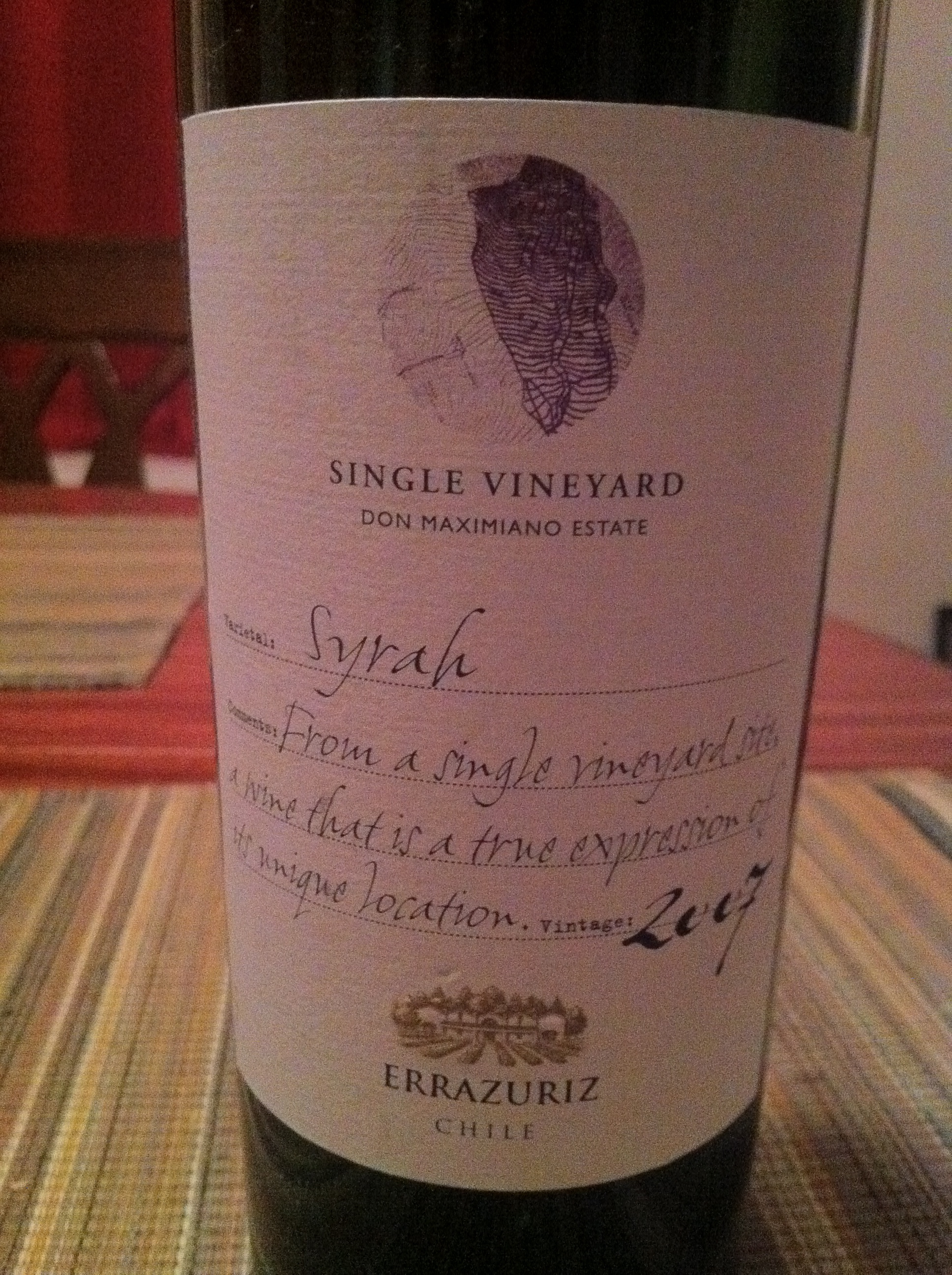
Wine: Errazuriz Single Vineyard Syrah 2007

Notes:

Holy buckets was this steak delicious!  100% pure grass-fed beef and grilled to the cooked side of medium-rare.  The meal itself was fairly simple and the marbling on the steak softened so nicely that it didn’t require an overly tannic red to enjoy.  A great piece of steak that is cooked to that melt-in-your-mouth perfection really doesn’t need a Cabernet Sauvignon with it no matter what you’re friend’s cousin thinks who claims to know everything about wine.  Tannins, those polyphenols found in the solid parts of grapes (and thus in red wine) and from oak aging help break down the fatty parts of meats.  Too much tannin and too little fat results in that cottony feeling in your mouth and too much astringency.  Too little tannin and too much fat results in you chewing on that gristle and hoping you don’t choke.  Given the prevalence of bad steaks cooked in America, I believe the over-generalization of having a Cab. Sauv. with your steak came about.  While you certainly want a big Cab. Sauv. with a big, tough steak, my ideal piece of red meat lays in succulence.  Marinade and/or slow cooking is the only way to go if you have a good cut.  However, if you’re invited to a backyard BBQ and you’re uncertain of the hosts grilling skills, bring a varietal Cabernet Sauvignon.  You can at least cover the taste if you have to choke it down.  However, the Single Vineyard label from Errazuriz produces a delicious Syrah with a bit of complexity behind it and a decent finish to add to the succulence of a perfectly cooked steak.

Rating: 5/5

Aaron Berdofe’s new album: Rising

Wine: Maquis Lien 2006

Notes: It’s the first crossover post!!!  This will be posted in conjunction with the Aaron Berdofe Music blog. So the new album is officially done.  In the can.  Mastered.  Boom.  And I bet you didn’t think you could pair wine with music.  Well you can.  There are actually people in California (where else?) studying this and trying to boil it down to a science much like pairing wine and food is.  Did you think I would just sit and listen to my new album? No! I’ll have a wine that is silky smooth, but has some complexity to match the music I’m hearing.  I am continually searching for a Syrah/Carmenere blend from Chile here in the good ol’ U.S of A. because I was blown away by them down in in the land of good Pisco.  However, about all I can find are the Syrah/Carmenere/Cab. Franc/Petite Syrah blends that Casa Lapostolle made world recognizable in 2008.  Maquis Lien is one such blend of the four grapes so I decided to pair it with my final listening session merely an hour after I bounced my last mastered song off of my upcoming album: Rising (due out very, very soon).  Unfortunately, the locale of the release party does not carry this wine, but they do carry some other tasty ones.  So stay tuned for upcoming dates!  And for those food/wine purists out there: have this wine with a spicy burger and some avocado on top.  But go listen to the music while you’re chowing down!

I know it’s odd that I’m actually posting a holiday related item on the holiday itself since I never do that, but do yourself a favor and go pick up this wine and make some cookies tonight!

Rating: 5/5

Orange-Cardamom sugar cookies!

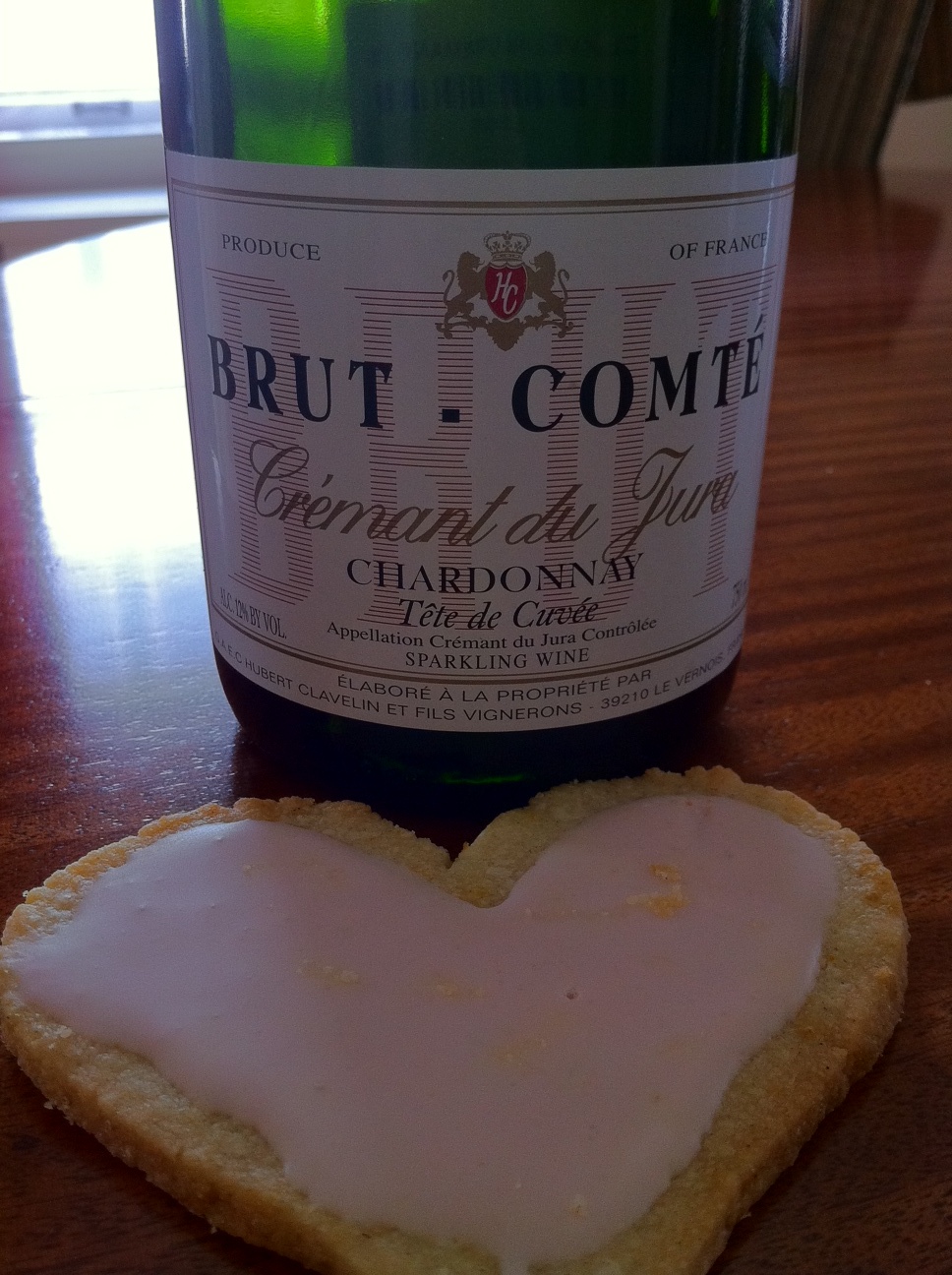
Wine: Domaine Hubert Clavelin “Brut-Comté” Cremant du Jura NV

Notes:

This is about as close to Champagne as you can get without actually getting Champagne.  Names or “brands” in wine are something I’m kind of a stickler for.  So Champagne only comes from Champagne, France and is made in the traditional method.  Champagne is a white-sparkling wine.  Not all white-sparkling wines are Champagne.  Got it?  Calling all white-sparkling wines Champagne is like calling all sports cars Ferraris. [Stepping off soap box now.]  This wine comes from Côte du Jura (not in Champagne) and is an excellent value.  Champagne can get quite expensive and this ran about $20.  Pairing this with orange-cardamom cookies was a fantastic idea even though it would be just fine alone or with a number of other things.  I’m a bit of a cookie monger (not to be confused with monster), so one could say a way to my heart is through cookies.  I’m even eating one right now.  How did that touch of pink get in the frosting you might ask?  Food coloring? No! I found a 3 year old box of wild strawberry JELL-O hidden in a cabinet and added a dash of that.  Who knew?  This is how I contribute to other people’s projects.

Rating: 5/5

Pan-fried Mahi Mahi and Slippery Lobster Tail in spices.  Mangoes, kiwi, avocado, fresno pepper and cilantro in lime juice to top.  Spiced rice and black beans baked with jalapeños on the side.

Wine: Recanati Yasmin White 2008 (70% Sauvignon Blanc, 20% Emerald Riesling, 10% French Colombard)

Notes:

There’s nothing better in the dead of a Minnesota winter than having a fresh meal to remind you of the sand and surf.  Fish tacos and some Sauv Blanc!  Recently, I had come across some Israeli wine that I wanted to try (Yeah, they produce wine in addition to having border skirmishes and it’s starting to be really tasty.) and why not have some bright cheeriness in the middle of winter.  The wine works wonderfully with fish tacos that have a little spice to them.  The Sauvignon Blanc is full of crisp citrus and tropical flavors and the Riesling acidity cuts right through the spice.  Come to think of it, some mint would have been a nice addition to this as well.  Perhaps next time with some couscous…

Rating: 4/5

Potato Latkes with applesauce and sour cream as toppings.  Sticking to the basics here!

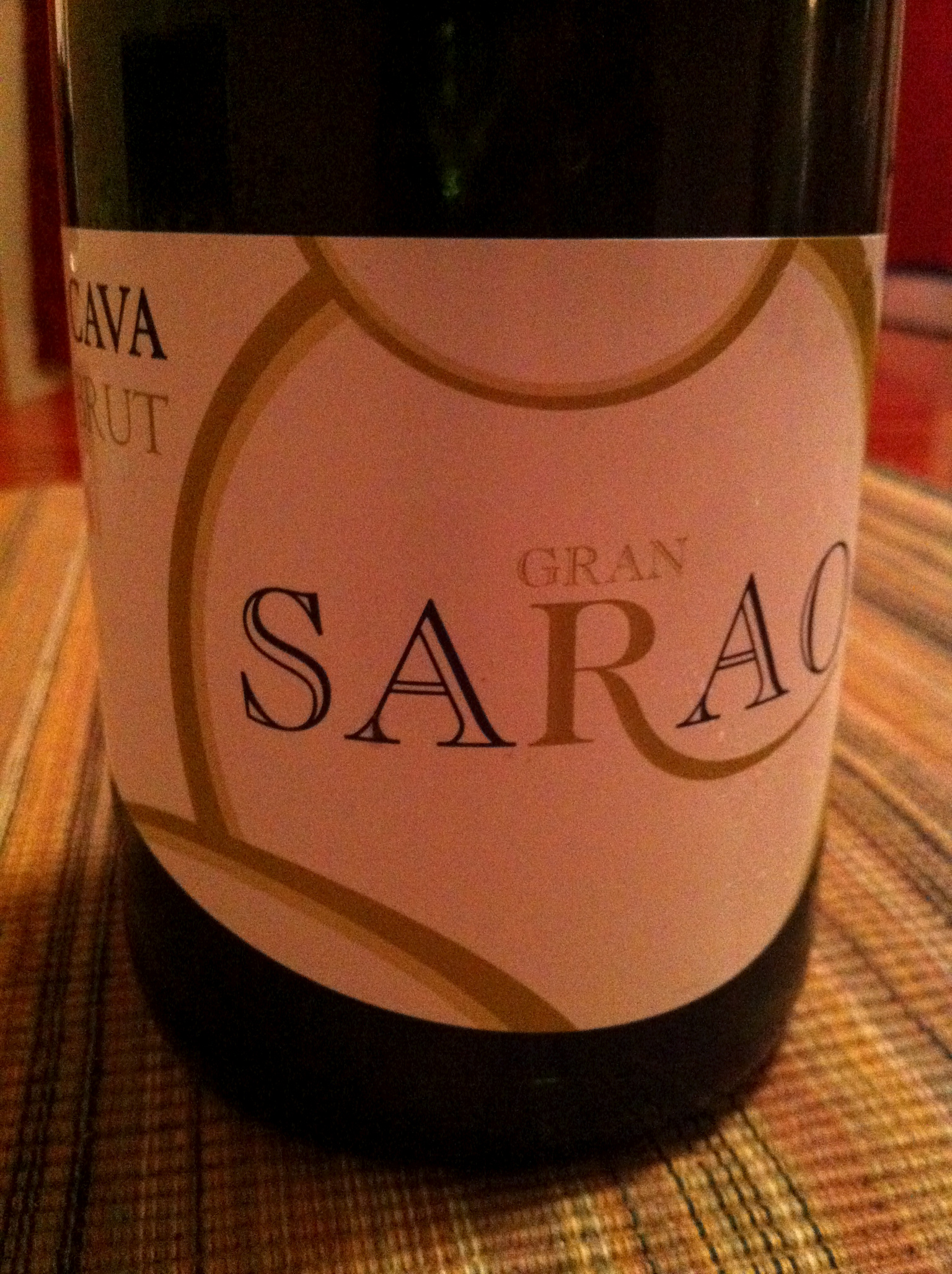
Wine: Gran Sarao Cava Brut NV

Notes:
So this is a bit late if you think of this as a strictly holiday meal.  I grew up eating Latkes throughout the year though.  However, the Latkes I grew up with were nothing more than grated potato and minced onion smashed together.  In this version I added both mashed and grated potato with the onions and some matzo meal to boot.  This adds a bit of heaviness that I didn’t previously have.  And why not pair some Latkes with some Cava? Apple to play with the applesauce, yeast to play with the matzo and potato. Some dry bubbles to take some of the oil away.  This was a pretty good pairing!  However, I could have preferred a bit more acidity in the wine to cut through some of the heaviness of the Latkes.

I recently came across three different wine related items that I wanted to post on. Fortunately, I was able to meld these into a single, succinct trifecta post for your reading pleasure.  Each of these  deal with a topic I tend to talk a lot about at my Wine and Food Experience events: Buying wine.  Why is buying wine so difficult?  For you, that is, since you’re reading this.  Not wine nerds.  We find it pretty easy.

Freakanomics Radio:
Take a listen to the podcast.  It’s only about 5min. long.  In it, they talk about the economics of wine, because it is and industry after all, just like everything else.  The question they ask is how do we as consumers know what wine to buy.  We buy wine to enjoy it. So how can we make sure we’ll enjoy the bottle we buy? They reference an article by the Journal of Wine Economics  that states the people enjoyed expensive wines slightly less than they enjoyed cheaper wines.  The reasoning behind this (mine, not theirs) is simple. Buying wine, like buying anything else is a value proposition.  As long as we think we’re getting a deal, we’re more likely to enjoy something.  If we just bought a Picasso to show off to our friends, the experience will be…well, rather fleeting.  Because the general public in America knows next to nothing about wine we look to the experts to tell us what to get.  In the podcast they mention the 100 point rating systems that are common these days, but what they neglect to mention is that these rating systems are rating the wine quality not whether you’ll enjoy it or not.  This is much like a movie critic rates a movie.  Critics are wonderful for these purposes of judging quality of something because there are some hard and fast values that they are judging.  Much like a movie of a certain genre needs to contain certain elements (quantitative) and those elements can be graded (qualitative) wines are critiqued in the same way.  For example, all Cabernet Sauvignons will have similar aromas.  There is a range of what a Cab Sauv can smell like.  It smells like Cab Sauv or it doesn’t (quantitative).  Now how prominent that aroma is and the blend of the unique aromas within the range can all vary on a scale (qualitative).  All these ratings tell you is how good of a spot was picked to grow the grapes and the level of craftsmanship of the wine.  It won’t tell you whether you like it or not. Unfortunately, the podcast ends with no conclusion, no help and little information about how to actually buy wine. They even insinuate that only wine “snobs” buy more expensive wines and everyone else should buy cheap wines.  I always get a little worked up when people say things like this because it is simply untrue.  True wine nerds (or geeks) buy wines at a wide range of prices, because we appreciate the experience we have with each of them.  We also know that sometimes the best wine to pair with a meal, given our mood, is a cheap, simple wine.  Therefore, you can easily spot a true wine snob who doesn’t actually know much about wine if they flatly state that they won’t ever buy “cheap” wines.  The price you pay generally has to do with either the legally designated ranking of quality within the country of origin or because the wine is a premium brand.  Let’s face it, with everything else you buy sometimes you get whatever is on sale and other times you like to treat yourself. Wine should be no different.

Consumer Reports:
The second item I came across was while I was pursuing through the latest edition of Consumer Reports.  Apparently, they are rating wine now.  They are also doing it very poorly.  I have no idea how long they have been doing this, but they should either stop or rethink how they are doing it. Electronics, for example are rated on a number of factors like battery life, features, etc.  They’ve rated wine on…well, seemingly nothing except price.  Wine prices range between $3 to $1,000+ a bottle with most wines consumed in the US being in the $10-$30 range.  The wines listed in Consumer Reports ranged between $7 and $22, but what were they rating them on? If they truly wanted to do it right, they would rate wines by how good of a bargain they are. Let’s say there is a wine that sells for $14, but its quality is at a level that it could sell for $20; that’s a good deal! They could even use existing rating systems.  Let’s say a wine is rated by the Robert Parker system at 89 out of 100 points and it’s priced at $12.99.  Or maybe a delicious wine that has been aged for 10 years in oak, crafted from the oldest vine in a highly regarded vineyard going for $50 when it could easily be sold for $75.  Consumer reports could say “We recommend!” but alas, they have taught the consumer nothing about wine.  Epic fail, CR. Epic fail.

Wine Spectator:
The last item I came across was an article from Wine Spectator detailing the current conversation our American wine industry is having about naming conventions.  Herein lies our answer!  Let’s face it, reading through wine labels is confusing.  Each country subscribes to different rules as to what can be put on the label.  Some countries are very stringent (France, Germany) and some are quite lenient (USA).  This means that when you see the word ‘Reserve’ on a bottle of French wine it means that it’s been aged in oak for at least three years.  If you see that on a bottle of American wine, it has most likely been aged in oak for a few years, but that doesn’t have to be the case by law.  So to make it a whole lot easier on the American public, we could define what terms like ‘reserve’ or ‘estate-bottled’ actually mean so you know what to look for.

In the meantime, always remember that location is important.  So below is a quick list of some good regions to find certain varietals of wine.  If it’s a blend of different grapes (varietals) make sure the at least the primary grape is grown in a region that fits it.  After you find the region you are looking for, then you can determine how much you want to pay.  Always know that the more specific they are about the location, the more unique and fun it will be.  Keep in mind that the list below of regions or collections of regions is not exhaustive by any means, but the chances of you getting a bad wine while using this list are minimal.  There are many great wines in varietal or blend form from numerous other places in the world.  This is my “play it safe” list and I’ve limited it to just the Noble varietals.  It should also be noted that you’ll rarely find a <$10 bottle of wine from these specific regions (however, one of my favorites from Paarl Hills, South Africa frequently goes on sale for $6.99 a bottle!). Legally speaking, their governments have established standards that they must meet so they can justify that their wines are of a certain quality.  Want to know what the difference is between a $3 bottle of Merlot from California (not specified where in the state) is compared to a $30 bottle from the Napa?  You’ll have to try it.

Chardonnay:

  • Burgundy (France)
  • Napa or Sonoma (USA)
  • Southeastern Australia (Most regions)
  • Piedmont (Italy)

Sauvignon Blanc:

  • Loire Valley (France)
  • Bordeaux (France)
  • Marlborough (New Zealand)
  • Casablanca (Chile)
  • Sonoma (USA)

Riesling:

  • Mosel or Rheingau (Germany)
  • Alsace (France)

Pinot Noir:

  • Willamette Valley (USA)
  • Russian River Valley (USA)
  • Burgundy (France)
  • Southern New Zealand (Most regions)

Merlot:

  • Bordeaux (France)
  • Napa Valley (USA)
  • Walla Walla or Columbia Valley (USA)
  • Tuscany (Italy)

Cabernet Sauvignon:

  • Bordeaux (France)
  • Napa Valley (USA)
  • Coonawarra (Australia)
  • Tuscany (Italy)
  • Colchagua (Chile)
UPDATE:  Consumer Reports returned a message I sent them with some helpful considerations:

Dear Mr. Aaron Berdofe:

Thanks for taking the time to contact Consumer Reports®.  It is always a
pleasure to hear from our readers!

We appreciate your taking the time to write to us regarding our report on
wine.  Your correspondence has provided us with invaluable feedback on how
we’re doing.  Please be assured that our readers’ comments and thoughts
help shape the work we do.  I will, of course, forward your correspondence
to the appropriate departments for their review and consideration for our
 future reports.

Thanks again for taking the time to write.  Your interest in our work is
 greatly appreciated.

Sincerely,
[Name Removed]
Customer Relations Representative

Autogenerated epic fail.


Rating: 5/5

Roasted venison loin (medium-rare) marinated in red wine, pepper, sage and gin (which apparently makes a nice Juniper Berry substitute).  On the side: Minnesota wild rice with cranberries and sauteed green beans in lemon and garlic.

Wines: Château de Ségriès Cuvée Réservée 2008, Domaine de la Ville Julienne 2007, Yoakim Bridge Zinfandel 2006

Notes: No, I didn’t drink all three bottles by myself.  If you know a hunter, which you inevitably will if you live in Minnesota and you have some venison lying around in the freezer, you have to cook it for them.  I think it’s a rule or perhaps just a good idea.  Marinating the roast made this venison extremely delectable.  To boot, the wines were mind-blowingly delicious mixed with this meal.  I think I’m still speechless from how enjoyable this all was.

Rating: 4/5

Braised Elk steaks with a rub of pepper and sage with a cranberry chutney drizzled over it.  A side of brown rice with boiled acorn squash and cooked cranberries thrown in.

Wine: Yoakim Bridge Merlot 2007

Notes: I really need to figure out how to give wild game a little more juice after they come off the heat. The next experiment will be to re-inject some of the juices the meat is cooking in back into the meat as it cooks.  Outside of that, this was another great meal for the fall.  Hunted game (read: ultra-manly, except that someone else did the hunting) with a suitable side and matched with a wine from one of my current favorite wine producers out of Dry Creek Valley in Sonoma.  I’m really digging the combo of using sage on meats and having a great merlot.


Rating: 4/5

1/8″ thick slice of fresh mozzarella wrapped in prosciutto and then flashed fried on the skillet in some olive oil.

Wine: Owen Roe Sinister Hand 2009 – 70% Grenache, 25% Syrah, 3% Mourvedre, 2% Counoise

Notes:

This wine was so tasty on a brisk fall day.  Peppery, earthy, balanced tannin and a wild strawberry punch to knock you into submission.  It has enough body and just enough tannin to take on the fat (prosciutto) on fat (mozzarella) on fat (olive oil) delight, break it down in the mouth and make for a satisfying stay in your stomach.  I maxed out at 4 of these, but I was in love. The more health-conscious eater might stick to just 2.