Another example of how loquaciousness would get the best of me if I wrote tasting notes.
I lay in a field of lilacs. The coolness of a spring breeze lightly brushes over my skin as it wisps across the prairie. A butterfly anointed with yellow and blue flutters by as I raise another bit of fruit to my lips; tasting, lingering over the lusciousness of it. The day moves slowly laying under these few wraiths of clouds painted onto the benevolent sky. Life moves like a glacier.
The simplicity is what is astounding. Seemingly, there should be layers of complexity, webs of mathematics beneath the displayed elegance before me, but alas, I can see none. The purity of the flowered air is only impugned by a hint of baking spices in the near distance. And this, yes this mere whisper of spice is enough to arouse my appetite once more. “The day is young.” I declare to the butterfly and with that I rise to my feet in pursuit of more substance.
My home of Minneapolis is full of people who are rather enamored with beer. I’m not talking about bros grabbing a cold one as they scan for ladies between rounds of Buck Hunter* (as apparently all of us do according to a now infamous NY Times article). What I’m referring to is the insurgence of Craft Beer that has gained a strong foothold bolstered by people passionate about not just drinking beer, but how it’s made, how it works, and most importantly, how to infuse unique and artistic flair into something that has long been a mass-produced product. Admittedly, I can in no way be classified as a “Beer Drinker”, but I still watch the movement as well as sample their progress along the way because it’s cool.
As the movement has been progressing it has been looking to the world of wine for a little guidance. Some of it has been general instruction on how be called “Fancy” at dinner parties, but there has also been a push to pair beer with food á la food and wine pairing (the greatest experience known to humans). Honestly, most of it I have seen thus far has been, to put it very nicely, a bit of a stretch. Food science is generally ignored with this effort and it seems mostly to be an exercise in filling content for media to gain the Craft Beer lovers as a readership demographic. So it was with that mentality that I quickly read a few lines of an article entitled: “Beer Vs. Wine” in our local beer rag, The Growler. I skimmed over the first few lines of a portion someone had pointed me to about pairing beer with food and promptly walked away with disgust. The author had sought guidance from a sommelier who gave him a list of Dos and Don’ts and I thought to myself “There is no hope for these people!”
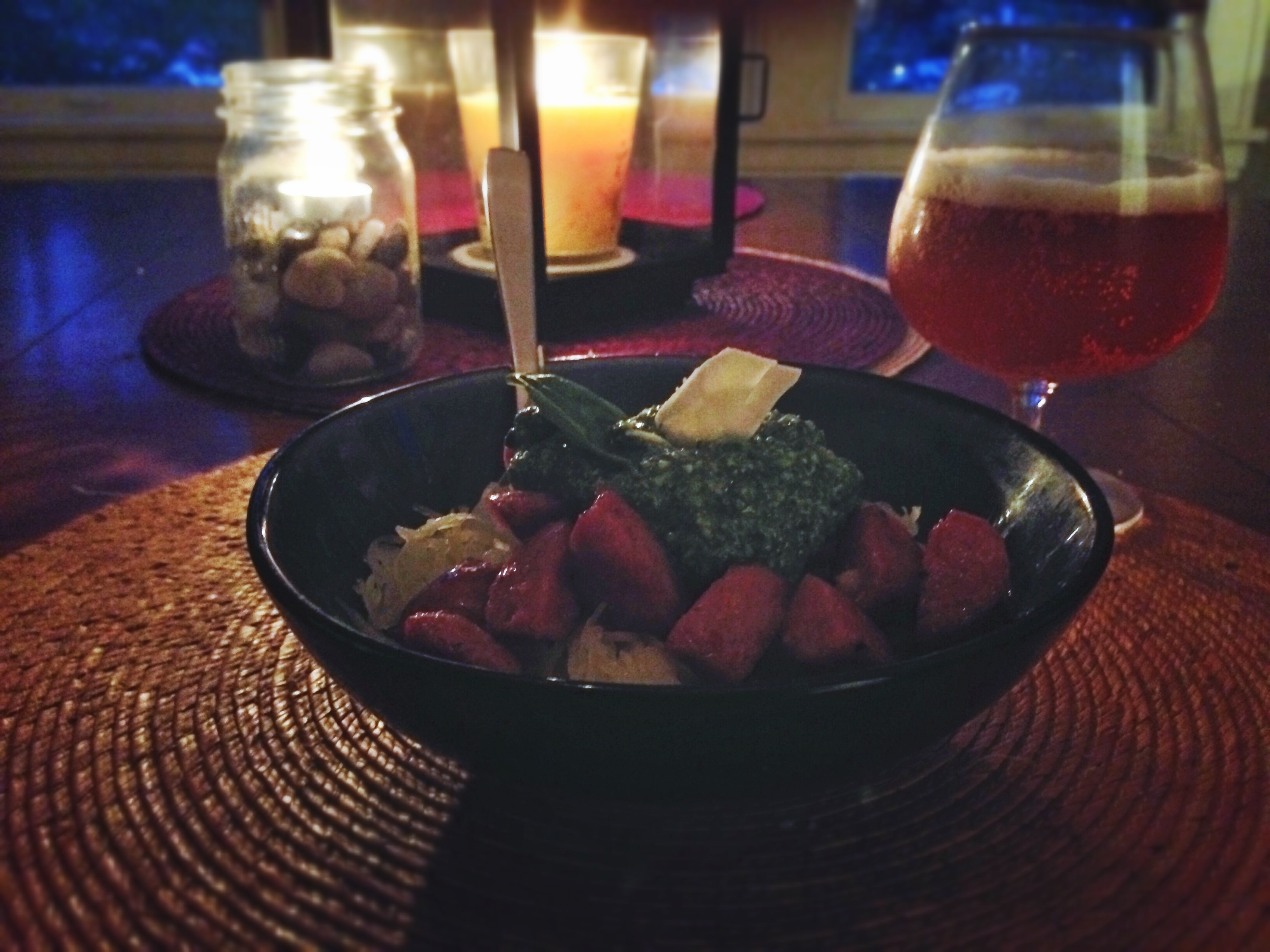
After having a brief conversation immediately following that about why I thought pairing food with beer was worthless (Yes, it was mostly me talking), I began to question whether that was an accurate statement. This was after of course actually pairing a seasonal lager with a dish of andouille sausage and walnut/spinach pesto over a bed of spaghetti squash as seen above and struggling mercilessly to define whether it actually paired well or not. The next day I actually read the full article and you should too. It’s a pretty good article. The author’s conclusion is actually that beer and food pairing is just beginning so people are still feeling their way around the whole concept which I would say is a good summary.
Yet over the past 24 hours my mind has begun to ponder possible interactions between beer and food and I’ve decided that what the beer community really needs is a good framework in order to begin to hash out their own guidelines (not rules) about beer and food pairing. With that, I humbly offer some points from the evidence-based wine world to get them started. I honestly look forward to future progress and I think there will be some surprisingly wonderful results.
Work with good chefs.
The craft of wine making developed alongside the craft of cuisine. Why it was wine instead of beer or another beverage, I have no idea, but regardless, this means that wine and food already have a partnership. Wine makers have generally assumed that their product was to be consumed alongside food and chefs traditionally assume a fine meal will be accompanied by some wine. In other words, sometimes they are literally made for each other. However, if a chef designs a meal with a specific beer in mind, the results will be much better than just trying to pair a beer to a dish already thought up. Keep in mind though, that I don’t think any beers are made with the specific thought that they should be consumed alongside a meal. So once the chefs are willing to give a little taste of what they can do, it would be best to return the favor.
Map out the relationships between the components of food to the components of beer.
This is something the wine world is just starting to do, but the fact that knowledge exists on this topic, it should be incorporated. Maybe I’m missing it, but I can’t find where things like acidity or alcohol are being evaluated on standard beer evaluation methodologies. Maybe they don’t matter when judging the quality of a beer, but they sure do matter when pairing with food. What happens when you mix the varying acidity levels of beers with spicy foods? Why do parts of beer (i.e. carbonation) go well with salty foods? Ask questions and try stuff out. This is an area I can certainly help with. From this experimentation, guidelines can be developed and referenced.
Avoid Dos and Don’ts. Especially Don’ts. Focus on explaining the experience.
We have plenty of fallacies in the wine world that have manifested themselves into rules about what we should or shouldn’t do instead of just stating why something we are experiencing is happening. There are plenty of sommeliers that will tell you never to pair a big tannic red with a light fish. However, if you cook up that fish in a creamy or butter sauce, make sure there is enough salt or citrus acid to reduce the astringency from the tannins, and then force the pairing down someone’s throat, they’d probably think it was pretty good. Therefore, once you have guidelines based on what is actually being experienced in a pairing, let the chef planning the menu or the person consuming the meal decide whether or not they want to experience a certain aspect of the pairing or not.
Encourage the consumption of beer with a meal. Not necessarily by itself.
This is something America as a whole needs to do a better job of. There are a whole host of reasons as to why drinking with a meal and not consuming alcohol by itself leads to a healthier lifestyle. Having the Craft Beer movement be part of this push though would also help establish itself as a beverage that can add to the dinning experience.
Consider alcohol levels.
The alcohol content of wine has slowly been inching upwards so now wines are more commonly reaching the 15-16% ABV levels. It is generally agreed that these higher levels may perhaps be too alcoholic to blend with a dish because they start to overpower them. We are also seeing fewer wines being sold in the 11-13% range which is unfortunate, because this is a generally appreciated area for alcohol to be when being paired with food. So while beer generally sits below the 5% range, some of the more crafty ones are being delivered at higher levels with good results. Now, I think this will vary with the type of beer being made, but my personal opinion is that the most sublime opportunities for beer and wine pairing will be with beer around 9% ABV. The point is that the wine world is leaving the bottom level open for you if you’d like to come in out of the rain.
*As an aside, I played Buck Hunter for the first time down in Iowa a couple of weekends ago…I still don’t get it.
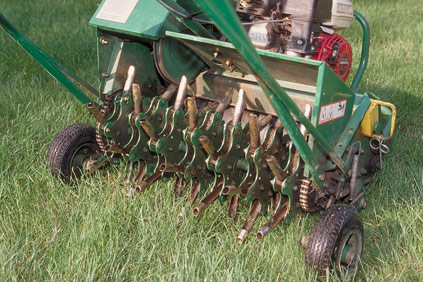
And if you just put your glass of wine underneath like so…it’s gonna taste better.
A while back, I wrote a post on hyper-decanting and how oxygen affects the aromatics of the wine right before you drink it. Apparently I wasn’t very clear in one respect though so I’ll be exceptionally clear now: Don’t buy wine aerating accessories. They are stupid. Now, I know everybody that read up on my experiment shuns toys like the Vinturi, but apparently people keep buying those things; so as a PSA, please tell them to stop doing so for their own good. If you’d like, have them read through their patent application and find where it states how their method of aerating the wine will improve the wine. They won’t be able to because it’s not there. Fun fact: Vinturi is gimmicky derivation of the Venturi Effect which describes the reduction in fluid pressure experience when the fluid flows through a constricted piece of pipe. The concept is generally used to mix liquids, gases, or a combination of the two at a different pressure than they would be just dumping them together.
This is not to say that you shouldn’t decant or swirl your wine up with oxygen (with or without a motor-powered mechanism to do so) to get those aromatic compounds moving about. But I haven’t found a single, impartial taste test done that shows a Vinturi would be a solid purchase to aid your wine drinking habits. Even these folks at the Huffington Post who don’t know much about wine couldn’t support it.
Let’s review the 101 on oxygen and wine aromatics:
Oxygen is generally avoided during the process of making wine because fermentation is an anaerobic process.
When oxygen interacts with finished wine, it aids in releasing aromatic compounds.
Different aromatic compounds have different densities. If we could visually see what we smell in a glass of wine we would see the fruity aromas sitting up at the top and the earthy odors down towards the bottom. This is why Riedel feels that everyone needs a different glass for every different type of wine, which I feel is slightly flawed logic.
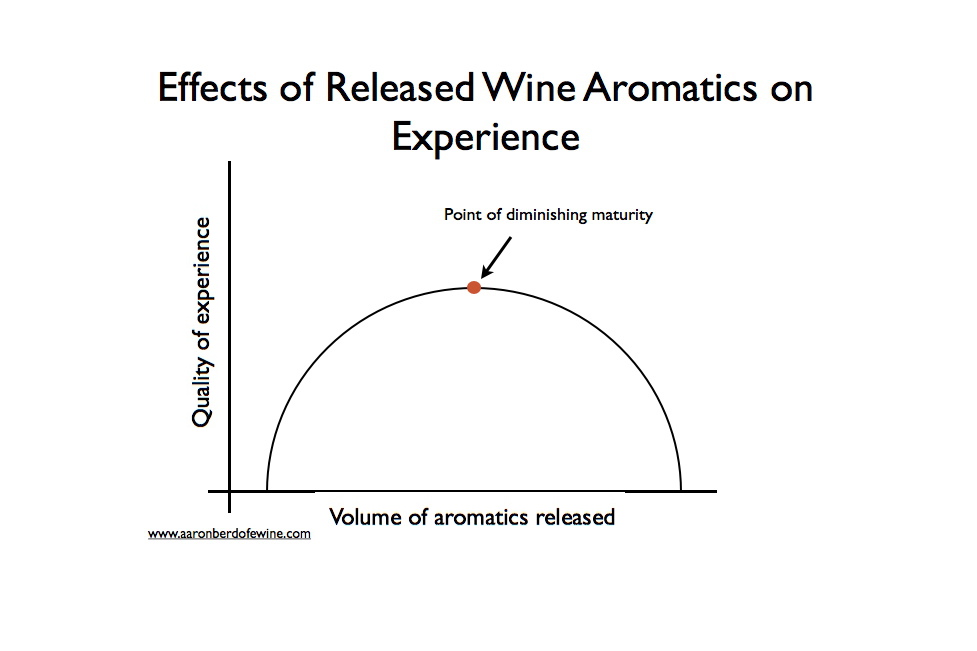
There is a finite amount of aromatic compounds in a glass of wine. The most enjoyment comes when they are at the peak of their release (or escape if you visualize them as imprisoned revolutionaries, as I do) and the varying compounds are being released in balance to one another. I developed this popular chart and the term “Point of Diminishing Maturity” previously to assist in learning how this works:
Usually the length of time a wine will need to be decanted, or to just sit there until you find it best to drink depends a lot on how far along the maturity path the wine already is. If it’s an old and tannic red wine, it may take up to 2 hours in a decanter to “wake up”. If it’s a vibrant young wine that just needs a little settling down, it could take 5 minutes.
Your preferences as to what you view as being “perfect” will be different than someone else’s.
Given these points, here are some reasons why one would want to decant or hyper-decant a wine:
Off-odors exist. A lot of these off-odors (sulfur, garlic, cabbage, rubber) tend to have a lower density than the desirable aromas and thus would “blow off” or dissipate.
The wine aromas seem unbalanced. Pour it out. Let it sit. See if they readjust themselves. However, it could be just that the wine itself wasn’t made that well and is inherently unbalanced.
The wine seems “Tight” or you don’t seem to be getting much aroma off of it. I find that a lot of this problem can be resolved by letting the wine warm up a little bit, especially with whites. Letting the wine sit in the bottle or a decanter for awhile usually has the desired effect too. You can also do a little Hyper-decanting if you’d like.
Oh, P.S. a milk frother works pretty well for hyper-decanting. Bonus points: it can be done in your already poured glass of wine and it costs around $5 at Target. Whir until fully frothy and then let it sit for 5 minutes. Win!
Now here’s Vinturi’s claim:
Traditionally, decanters were used to aerate wine. However, decanting is time consuming, cumbersome, and inconvenient.
Let me correct their marketing departments warping of a fact first:
Traditionally, decanters wereare used to aerate wine.
Now, let’s examine the remaining claims about how evil decanting is.
Time consuming. The active time it takes to decant a bottle of wine is approximately 10-20 seconds depending on how fast you are pouring the wine. Then you let the wine sit in the decanter between 0-120 minutes depending on the wine. With decanting mentality, the time you let the wine sit depends on what the wine needs. With Vinturi mentality, Vinturi give you one length of time for their “processing”.
Cumbersome. Decanting a bottle of wine requires you to not only open a bottle of wine, but to also get a decanter out and pour the wine into it. If you don’t become exhausted doing that, you may find the energy to drink your wine after this is complete. The Vinturi method involves holding their device perfectly above your glass and making sure you pour the wine at the correct speed so it doesn’t overflow the device every single time you want a glass of wine. …Yeah, their method is much less cumbersome.
Inconvenient. I’m not quite sure how they are justifying that their Vinturi device is more convenient than a decanter, but I would back up the claim that it’s easier than hassling with a blender for some hyper-decanting. However, you probably already have a blender so you wouldn’t have to spend $25 on a new kitchen gadget (compared to a $5 milk frother). Admittedly, people spend a lot on decanters because they view them as works of art, but that means the decanter is solving a person’s need to feel “arty” as well.
To recap, the amount of oxygen that needs to be mixed with the wine before you deem it to be “perfect” to drink will vary greatly between wines and between people. Therefore, a “One-size-fits-all” device probably can’t be justified as being appropriate to tackle the problem of getting the wine to the point where you think it’s perfect to drink. Please file this under evidence supporting my notion that the vast majority of accessories for wine are stupid and pointless.
The box tinkled as I lifted it, catching the ear of the Riedel (pronounced “REED-uhl”) sales rep. “That’s not good…” No, it certainly was not good. A hundred or so boxes later, the damage was totaled up. Around 80% of the boxes containing 4 different Riedel wine glasses held at least 1 broken glass; generally the Chardonnay glass. As we carefully separated out the broken glasses from those still intact, the presenter of the tasting session racked her brain to come up with Plan B. The rest of us furiously, yet carefully wiped down the remaining glasses to a sparkle. I, only utilizing nine fingers, successfully avoiding getting blood from the tenth on the glasses like a true professional. It’d probably be more understandable if I had cut myself on one of the broken shards, but no, I had received a paper cut from one of the cardboard boxes. Yet even with one glass down, the folks from Riedel made their pitch to a large group of conference goers as to why each varietal of wine deserves to be sipped from it’s own specialized glass.
Their reasoning behind having a multitude of glasses is this: each varietal has its own “signature” aromatic profile and they have designed glasses to highlight this. Oddly, I had previously thought that they had just wanted to diversify their product line and increase sales. To demonstrate, they pour out a single wine into it’s “appropriate” glass and then have you pour the wine into the other glasses to compare. They also acquire a “joker” glass, in this case, the squatty wine glass the hotel’s banquet service utilizes to act as a control. Think of the wine glass you get at a wedding.
Halfway through the tasting (or smelling as it were) the sales rep asked if anyone was not convinced yet. The lone enologist in the room raised her hand. Since I was assisting the event I merely whispered my support to her discreetly. Truth is, I’m not convinced either.
There are a few things about their pitch that just don’t work for me. First and foremost is that they pour a wine into it’s assigned glass and tell you that what you smell is exactly how that wine should smell. After this, they tell you to pour the wine into another glass and point out how it’s different, which they then define as worse. This is called Priming in the advertising/marketing world and while effective, I wouldn’t call it the most honest. Second, they compare their glasses against the worst glass possible. Third, they only focus on aroma, which to me isn’t the whole picture when choosing your glass.
However, I wanted to give this experiment a fair test. What would happen if I removed all of the factors that were designed to convince me that the Riedel glasses were not only superior, but variety/style specific ones were needed. Naturally, I went home and set up another wine-related experiment. Now, I have a wider variety of glasses than the average duck:
Bucking my habit of minimalism.
From left to right: Flute purchased from Crate and Barrel, Riedel Sauvignon Blanc glass, Riedel Burgundy glass, Ikea wine glass ($2.99!), Riedel Cabernet Franc glass, Red wide-bowled glass purchased from Crate and Barrel.
Unlike the Riedel experiment, I opened a bottle of Sonoma Zinfandel and poured the equivalent amount into each glass. As I went down the line smelling them there were again differences, but I honestly couldn’t put a preference on which glass I would go with solely based on aroma.
Here’s the deal, when you pour wine into a glass, the aromatic compounds that eventually get to our nose get kicked up into the air of the glass. Various compounds have different densities so they settle at different levels in the air inside the glass. Your fruity esters will be up top and some of the more earthy aromas will settle more towards the bottom. This density thing is generally why wine people swirl their glasses like pretentious pricks. It mixes the compounds of different densities and puts them in the air above the liquid for your olfactory pleasure. Think of it as an aroma emulsion.
Sommeliers across the world generally deal with three glasses. A white wine glass which is taller than it is wide, a red wine glass that has a wider bowl than the white wine glass, and a glass for sparkling wine which is thin and tall. According to standards committees (the ISO) the best glass for tasting is one that is half as wide as it is tall. Regardless of which glass, the rim should always be a little more narrow than the bowl. Those are the few specifications that the industry agrees that work.
What I have found is that the wider the bowl of the glass, the faster the volatile chemicals of the wine (the aromas) will dissipate. For reds that seem “tight”, this is good. More oxygen hits the wine which releases more parts of the aroma. This is also why people want to decant wines, leave the bottle open for a few hours before serving, or put the wine in a blender. Oxygen releases aroma. BUT, the general trend for American wine drinkers is to be overwhelmed by the aromas. Therefore, depending on how fast you drink your wine, you want a bowl with a size that matches your appetite for wine. It should be noted that red wines contain a higher amount of polyphenols in them which are anti-oxidants so that’s why glasses for red wines have historically had wider bowls than for whites. Therefore, your enjoyment of a tannic red wine might not be different when had in a white wine glass as long as you drank it over a period of a few hours. On the flip side, you might find that the aromas of most white wines diminish too quickly when served in an airy glass.
But back to Riedel. The aroma difference between the Riedel Cabernet Franc glass and my closest non-Riedel glass (The Ikea one) was close to nil. The minimal differences in the shape of the glass really did not make a difference. However, the Riedel sales guy left out a few factors which greatly add to the experience of drinking wine, that of the size (and direction) of the lip of the glass, the balance of the glass overall, and the quality of the glass.
Riedel Cab Franc (Left), Ikea (Right)
A thin lip that points up or slightly out is less obtrusive to putting wine into your mouth (bonus). A balanced glass will let you roll the stem between your fingers as you gaze into its mystical depths (romantic bonus). And there is a positive correlation between the quality of the glass and the quality of tone you get when you clink two glasses together gently and then put one up to each of your ears (musical bonus). In other words, it adds to the experience overall. Admittedly, the Ikea glass fails at the musicality aspect since it’s cheap glass and if I’m being honest, I’ll generally reach for the Riedel Cabernet Franc or Burgundy glass. Why? Because they’re damn good quality glasses. It really has nothing to do with their intent to be used with certain varieties or styles.
To end this post, I will leave you with what I think its the worst possible wine glass ever made. I’m speaking about the globe glass, which you may find in nearly every mid-scale Italian restaurant. It makes you feel like you’re drinking upside down when the glass is full and when it’s nearly empty you have to turn upside down, just to get the last few sips.
Great river-view patio. Worst wine glass ever.
So there you have it. Now let me go find the next trendy Minneapolis cafe that feels the need to serve wine in tiny tumblers.
Another example of how loquaciousness would get the best of me if I wrote tasting notes.
It was mid-morning by the time we set out on horseback with the smoke of the morning fire still tussling our clothes. Open plains were spreading before us, rising into the mountain range beyond as the sun began to beat down through the painted clouds that dotted the sky. The day wasn’t particularly hot though as the fall of the autumn leaves was approaching; just enough to warm your back and easily fight off the overnight chill. With the sizzle of a match, one of the caballeros lit a rich cigar. The aromas encapsulated my entire olfactory experience briefly before giving way to the more delicate scents of the dark fruited berries and wild thyme lining the path. In the dryness, the horses’ hooves kicked up the earth, casting a gritty and somewhat muted tone on our surroundings.
The group was quiet, as if contemplating the finer intricacies of life’s greater mysteries. Therefore, the only sounds to be had were that of our equine companions trotting along and the soft breeze rustling through trees. If I had been a simpler man, I may have let the rhythm of the journey lull me into a blissful sleep, but I have seen just enough of the world that my mind stayed on alert, casually scanning the horizons for anything with less-than-noble intentions. Fortunately, our band remained untroubled by any potential interlopers and my mind soon began drifting through the rich history of the land that lay before me. A certain nostalgia crept in, but lacking the bitter-sweetness of yearning for yesterdays gone by. Instead it was a feeling of completeness with the greater world. An emotion of being connected and impossible to describe with mere words any further. To do so would diminish the grandeur of the moment.
A great wine is one that not only connects you to a place, but to a moment. The rise of emotions, regardless of what they are, is the mark of a wine well crafted. This wine has achieved that in spades.
How about something new and exciting? As you all know, I tend to look down upon tasting notes. Mainly because they are subjective and also because wine critics tend to be a little flamboyant in their descriptions. One might also notice that negative reviews are also rarely published, which hardly creates a ‘Consumer Reports’ type guide for the casual drinker (Even CR failed miserably at doing this too). My great fear in critiquing wines besides being accused of playing favorites with wine makers is that I may end up being TOO flamboyant with my descriptions. But, like every other wine drinker out there, I feel the need to express my opinion sometimes. Therefore, a compromise between my principles and my penchant for writing ludicrous descriptions through run-on sentences must be reached. For the sake of the wine maker, I will not list the wine I am tasting (even if it is outstandingly good), but be rest-assured these are all based on actual experiences. The astute will probably at least be able to pick out the varietal and where it comes from. With that, I give you The Tasting Notes Series (TNS for short). And because I’m sure you’re all jazzed up about this now, here is the first one:
The Tasting Notes Series: #1
Drinking this wine I am reminded of a foot race I used to run in the middle of February across a frozen Chequamegon Bay in northern Wisconsin. As the sun would slip down past the horizon, the winter chill took over bringing the temperatures to hover around zero or below. No matter how many times one is exposed to the steely frigidness of the Northlands, it will always take the breath away the next time it settles in and finds the cracks between the layers that have put on. The race was of course at night and the scene was reminiscent of thousands of Nordic warriors lining up for a battle in full armor, battle cries and all. Pyres ten feet high marked each kilometer, and for the locals they sparked courage for only they seemed confident that the licking flames would not settle down through the packed snow and ice that separated the brave souls from an icy grave at the bottom of the bay. The course was also marked with ice lanterns, beautifully flickering through the night off their imperfect walls adorned with ice crystals. Upon initial glance one may be fooled into thinking this was a rite of passage into some Viking society and only the strong would survive, but the festiveness of it all was enough evidence to convince one that people actually do this for fun. The wind was enough to make one grind their teeth until the enamel was burnt away leaving a crisp, yet slightly acrid taste in the mouth. Each footstep was uncertain in its placement on treacherous terrain, but the dedicated pressed on with hope of a brightly lit finish line in the distance. In the end one expected fireworks, but they never went off at the right time and the feeling of landing the final step would quickly diminish as it was realized that the building climax to this journey turned out to be rather anti-climactic. The reward was merely accomplishing the feat and never having to do it again.
…That is to say that this wine should be served almost intolerably chilled and enjoyed for its simple, raw pleasures while being quickly consumed. It would certainly best be had in the high heat of a steamy summer day in order to take the edge off.
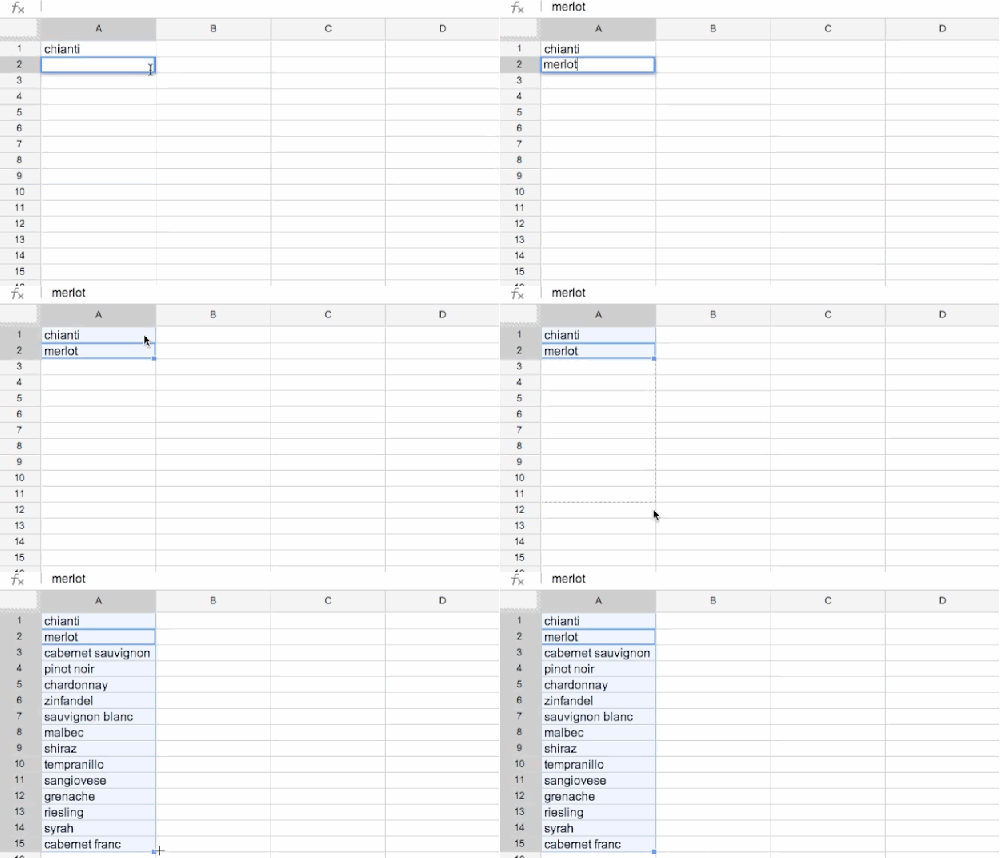
This would be cool if weren’t wrong. Chianti is a region in Italy that makes wine primarily from Sangiovese grapes. The rest are grape names. And then they threw in “Rose” a style of wine at the end. So close to being useful functionality. Is this why Americans are generally wine illiterate?
Despite the blustery snow of the Tuesday before the extended New Year’s holiday weekend, people still steadily streamed in to the Four Daughter’s Winery in Spring Valley, MN. A mother and her son, diverted from reaching Rochester to do their holiday shopping appeared to be successfully accomplishing their mission between the wine-related trinkets in the gift shop and the quickly disappearing bottles of wine lining the western wall. An elderly couple seemed slightly overwhelmed but curious about the menu items from the chef and a delivery driver deliberated whether to hold tight or press on as he acquired a bottle of wine for his wife. Yet, it was noticeable each time the staff patiently went through the wine offerings; no one was there specifically for the wine. Perhaps that crowd would roll in after noon.
The wine from Four Daughters, however, is what has recently been making a name for itself. At the International Cold Climate Wine Competition this past August, five of the winery’s seven entries received a medal. Their La Crescent took home the top honor of best wine at the competition. Not bad for an operation that recently celebrated their first anniversary. Much of this success is owed to their winemaker, Justin Osborne, whose winemaking history spans only as long as the winery’s. Justin, a Twin Cities native, was asked by his wife, Kristin’s family to be the wine maker of their future dream and fortunately for the Minnesota wine community, he accepted.
The question is: How did someone with little experience end up besting some with 10+ years of hard work and dedication? “I’m not the smartest winemaker in the world,” Justin modestly declares as he struggles to illuminate his process. “You do these four things well, and stay within the lines…you’ll have a good end product.” His goal is not to reinvent the wine making world, but to entrust solid wine making practices that have been proven to work. Yet, instead of taking large leaps and just hoping things work out, he takes small, measured steps at each point along the way. The content sigh of someone fully dedicated to their craft comes out as he points back to a little room off of the production that he has no doubt spent countless hours in. “I do a lot of testing.” The lab room at Four Daughters may be his second home or first depending on whom you ask.
So what are those four things needed to make good wine?
Grow good grapes
Get good juice out of those grapes
Have a healthy fermentation
Have a deft hand when refining (finishing the wine)
Simple, right? OK, there may be a few other factors going into the success. Being able to start off with some good equipment certainly helped. Additionally, Justin’s wife, Kristen is part of how the winery got their namesake. She’s one of the eponymous four daughters and her family’s agricultural background has certainly served them well in pursuing their dream to have a winery and vineyard not to mention the aid of Kristen’s marketing skills. The family and their expert staff didn’t walk into this venture unprepared. It also helps that the vast majority of the grapes they are purchasing are grown within 50 miles of their location. Their location also just happens to be within the largest wine region in the world: The Upper Mississippi Valley American Viticultural Area (AVA). See Justin’s number 1 rule.
Those visiting the winery may spot a life-sized cardboard cutout of Marilyn Monroe in a glimmering pink ball gown leaning on a wall of oak barrels. Is it inspiration for his Frontenac Rose? He shakes his head and begins, “My mother-in-law collects them…”. And really, that’s the only explanation a married man needs to give sometimes. He then relates the story of how the local police department, responding to a security alarm breach on the premises almost shot the cardboard version of John Wayne hanging out near the bathrooms. Clearly, it’s not just the customers who are pleasantly surprised by what they find what the find at this winery.
For the full audio interview check out the podcast below. Justin spills all of his secrets…well, almost. Regardless, if you make wine in the Midwest or just like drinking it you’ll enjoy the whole thing.
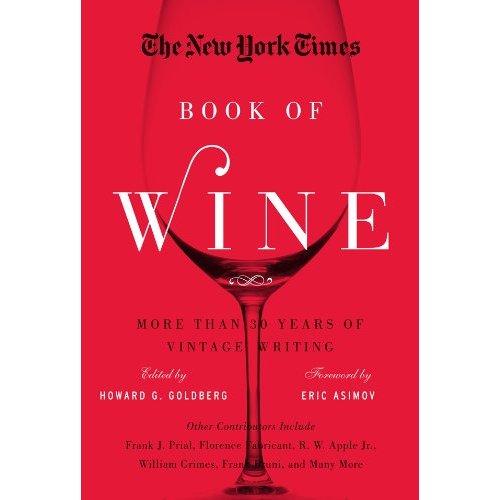
This may come as a surprise, but I generally don’t read wine-related books aimed at wine drinkers. I find most of these are filled with irrelevant wine trivia (which may or may not be accurate), current wine trends, descriptions of lavish/unattainable experiences in exotic locations, and occasionally a collection of “rules” that are based upon the author’s wine preferences and not those of the reader. So it was with some hesitation that I picked up the New York Times’ Book of Wine, which released earlier this year, on a whim.
I don’t think I have to tell you that this blog is not mainstream by any means, and if you asked me what wines are “hot” right now I most certainly would not be able to give you an answer. Looking at one of my bookshelves right now I have two wine sciences books, one of which is an actual text book and a how-to guide on setting up your own vineyard. Not exactly the readings of a guy who knows what’s hip and cool with the kids these days. And that’s why I picked up the book; It’s a collection of the NYT’s wine articles over the past 3 decades. What better way to see what the wine trends have been for the last 30 years and to actually figure out what’s been “hot” in the trendy wine world?
Burgundy. So hot right now. Burgundy.
At around 550 pages, this behemoth of a collection was a heavy companion as I took it on my hectic travel schedule through the end of fall. In my mission to extract the flow of wine trends over the past 30 years, it did not fail. Unfortunately though, the majority of articles were focused on the very topics I listed above which have driven me to avoid reading wine magazines and op-eds. So despite having to sift through descriptions of obscene opulence during dinner parties in mansions only accessible by boat and pronunciations that this bottle of wine that has only been tasted by 10 people is the best one ever (Because really, who are you to say it’s not? You’ll never be able to try it.), I did in fact glean some interesting tidbits from the collection.
The NYTimes has not so much been trying to shape and guide the conversation about wine in America over the past few decades. Instead, it had the conversation, it’s telling you about it, and you shouldn’t question their conclusions because you’ll never have the money to experience what they did. Fortunately, I believe Eric Asimov, their newest head wine writer is changing that.
The idea of drinking Wine as a “cocktail” (without food they are meaning, not that it is a mixed drink), is a concept uniquely American. And even though they just barely hinted at it in the articles, perhaps this is why Americans are generally accepting of wines with more and more alcohol in them which we don’t usually consider to be food-friendly.
Locally grown and made New York state wine would probably be as little known nationally as Minnesota wine is if it weren’t for having the New York Times nearby.
In wine writing, high price has always trumped any other factor in determining whether one will enjoy an experience with food and wine or not.
It’s good to be a wine writer for the NYT.
Wine vintages used to matter a whole darn lot, but have been slowly leaking out of the conversation about wine.
The wine world will lambaste anything new, but is really quite accepting of new techniques and methods after they produce good wine.
France, France, France, Italy, Spain, France…Napa! France apparently maintains the gold, silver, and bronze standards of wine culture according to wine writers who constantly ask themselves WWFD?
Robert M. Parker Jr. sets prices with his 100-point scale for the wine industry. Little is known what will happen when he’s no longer around which may be soon as current rumblings suggest.
The American wine drinker has evolved from the subset of rich Franco-philes (which believe me, still exist; I’ve had dinner with them) to a large swath of the upper-middle-class. While wine in Europe may be enjoyed by the working class and nobility alike, there is still a class division in beverage choices in America.
Eric Asimov has been the only wine writer for the NYT to actually ask questions at the industry. This is a much welcome change from a reader perspective and something I try to do in my own writing. Whether it is to confirm traditions or to usurp prejudices, questions should always be asked. Not only does this shake up the stodgy feeling of wine writing and bring it “to the masses” if you will, but Eric’s article entitled “Can Sips at Home Prevent Binges?” is a fantastic jumping point to a conversation about wine’s effect on our society. In the article he debated whether or not to give his kids sips of wine at dinner in hopes to not only instill in them a love of wine, but show them how it is properly used (to enhance a meal) and to teach them that it shouldn’t be abused or used as a crutch to relieve stress. What a wonderful conversation to have in a society where underage binge-drinking and alcoholism are a problem!
So despite me having to grumble through some more-than-poetic descriptors of wines and events 99.9% of people in this world will never experience, I have hope in wine writing. It’s moving from descriptions of high society to a conversation about wine’s role in society, albeit with some resistance. So while I generally focus on how you, the individual are interacting with and experiencing wine, I might start to look more at how groups interact with and experience it. But after it all, your guess is as good as mine as to what’s hot right now in the wine world. According to Google Trends the most common search term accompanying the word “wine” is “red” so….there you go. Red wine is where its at right now. Use that insider tip to impress your friends and don’t forget to tell ’em where you got it!
Readers of this blog will note that I adhere to a strict non-point-scale-giving, non-arbitrary-ranking-system policy. There is a simple reason for this: No regular person drinking wine is going to have an experience epiphany while manually tallying up observational points. Who gives a shit? I will point out the things that stand out in the experience of a wine though to help people find the words to describe what made it enjoyable or not. However, wine critiquing is something that needs to exist for any crafted product to help set prices and to establish an inherent and generalizable definition of value in the industry.
Therefore, I would be doing you, the reader, a disservice if I didn’t actually know how to critique wine. Fortunately for me (and you), I do. I follow a close version to what is taught in the International Sommelier Guild which is where I received some of my training. In order to demonstrate the steps for reviewing wine, I will be using the Gewürztraminer that I made the other month which is now strangely disappearing quickly every time friends and family are around.
Appearance
Clarity: Is the wine free of cloudiness, crystals, or other floaty things that you’d rather not see in there? This is relating to how well the wine was filtered and fined. However, it should be noted that the appearance of crystals (a result of a slip-up in cold stabilization) doesn’t affect the taste or smell. It should also be noted that some red wines are in fact, unfiltered. When tannin starts to bind and fall in the wine over time, it settles to the bottom. This is not a fault. Decanting will take care of this if you don’t like to have debris at the bottom of your glass, but some of us like this guy, do.
Color: What color is the wine? You’ll find “yellow” or “red” doesn’t cut it with the professional crowd or color freaks. You have to say some shade of “Straw” to gold for a white generally and a variation on ruby or garnet for reds. Really you’re just trying to determine if the wine is the correct shade of color for the varietal. If it’s brown, then something is wrong.
Color depth and brilliance: How deep is the shade of color and how much does it shine? Most wine critiques prefer wines that are rich in color and have a certain shiny characteristic (not unlike dog toys). If you process a wine too much while fining and filtering, you’ll probably take away some of the luster. The depth or purity of the color is really a preference though. Some claim it’s an indicator of overall grape quality, but that’s not commonly recognized.
Color pooling: How much does the color of the wine pool to the center? or is there a pale rim of color around the edge where the wine meets the glass? This is an indicator of wine maturity (not necessarily age). It’s not that the more color pools to the center, the better the wine is, it is more of an indicator as to how far along a wine is in its life.
Appearance of my wine: Clear, deep in pale straw color, no pooling.
Nose
I have a big nose. I get it.
Health: Does the wine smell healthy? If the wine smells funky then there’s probably something wrong with it. This could be a bacterial infestation (Mmmmm), general hygiene problems (usually also relating to bacteria), or way too much sulphur (smelling like farts).
Intensity: How much do you have to work to smell the wine? I range this between getting knocked over the head with smell down to needing to dig your nose in the glass to get the faintest whiff. A lot of critiques seem to like to be hit over the head.
Aroma/bouquet: What are you smelling? There is a lot of debate between the difference of aroma and bouquet so you’ll see them used interchangeably. The best definition I have heard is that aromas are the compounds that are inherent in the grapes and bouquet are the compounds that come about during the wine making process. So if you don’t know what the difference is this one might take a little work, but I can guarantee you that most critiques don’t know either. The easy way out is just to list what you smell. Then you verify that the wine you are smelling smells like what it is. For example, a common Chardonnay aroma from cooler climate areas is Green Apple. Does your Chardonnay have a Green Apple smell to it? It should also be noted that humans can only distinguish between 4 different aromatic compounds at a time. If someone is telling you more, you can call BS.
Nose of my wine: Healthy, mild intensity, aromas of peaches and lemons.
Palate
Marginally unrelated image.
Sweetness: How much residual sugar is residing in the wine? This ranges from sweet down to dry (with an addition of “brut” for sparklers). Despite what most think, the vast majority of wine produced resides in the dry and off-dry category. The measure of actual sugar in the wine should not be confused with the perception of sweetness that is mostly caused by…
Acidity: How much saliva rushes into your mouth after sipping the wine? If you ever hear someone call a wine “flabby”, they are stating that the acid of the wine is much too low to balance out the wine. As a general rule, the colder the climate, the more acid is in a wine. Therefore, if you like high acid Rieslings, don’t expect to like one from central California.
Viscosity: How heavy does the wine feel in your mouth? Is it vapid and wraith-like or does it have the characteristics of an iron fist wrapped in sweet sweet velvet? You’ll see this referred to as “Body” a lot, but I find that term is a bit vague for my taste.
Plus we aren’t supposed to sexualize wine descriptions anymore. STAY BACK SEXY PURPLE-ISH PINK WOMAN!!
Alcohol: How much alcohol is in the wine? Yes, trained tasters can identify the alcohol content of a wine just by tasting it; usually within 0.5%. Try me.
Sound wave: I’m pretty sure no one else does this, but I can feel how the wine floats through my mouth and visualize it like the shape of a sound wave. Does it peak early and fizzle out? Does it crescendo into infinity? I love this description because I think if every bottle of wine only showed the sound wave and maybe a few aroma descriptors, wine buyers would have zero risk in picking up a wine and knowing if they liked it or not.
Tannin: That cotton-wrapped feeling your tongue endures when drinking some red wines, coffee, or tea. Tannins bind to your saliva proteins which causes the dry feeling. Anything aged in oak will have tannin and anything which stays in contact with the grape solids for a while (reds) will some degree of tannin as well. The amount of tannin should be appropriate for the varietal and the style. The heavier the red, the more tannin it generally has. The longer it is supposed to have been in oak, the more tannin is imparted into the wine as well.
Flavors: Similar to the aroma/bouquet of the nose. Do they also appear on your tongue or are they different. Same reasoning too.
Complexity: How much depth does the wine have? Or how long does it make you think about what’s in it?
Balance: Do all of these factors balance together or does one stick out to some degree? Just in case there was any doubt: A balanced wine is a better wine.
Finish: After you swallow or spit (which is acceptable when tasting, but for some reason the ladies seem to think that’s hilarious) how long does the wine linger with you? Does it quickly dissipate or does it stick around? The length of finish can generally be tied to the level of quality of the wine.
Palate of my wine: Off-dry, with fresh-acidity, silky viscosity, around 12% alcohol, a sound wave with an even fade-in and fade-out reaching a moderate height, fairly simple in complexity, but well balance and a lingering finish.
So all-in-all my wine turned out to be pretty decent considering I was expecting it to taste no better than something that came out of jug. If I were going to put this wine out on the market, I could probably get $12-13 for a bottle at retail. Not bad for a first attempt.





![[Insert glass of red wine here to be trendy]](https://aaronberdofewine.com/wp-content/uploads/2012/12/blueberryplantation.jpg?w=500&h=500)



 Aaron Berdofe's Wine and Food Experience