For all of those in the Twin Cities this Sunday stop on out at The Homegrown Experience on Nicollet Island. Lots of local vendors for food, beer, and yes, wine! I’ll be giving a presentation at 1pm on the importance of locality in wine and an overview of Minnesota wine. Hope to see you there.
Posted in Education, Events, Fun Facts | Tagged local, locavore, Minneapolis, st. Paul, wine | Leave a Comment »
Recently, I just purchased a home down the street from where I used to live in SW Minneapolis and am almost moved-in. The joy of purchasing a home in this area is that the vast majority of houses were built in the 1920s. That is to say, you will need to do some work, get your hands dirty, and perhaps cry a little with frayed wires in your hand before you smile with joy at the place you now call home.
The reason I bought a house was of course so I could have a wine cellar (Is there any other reason?), but alas, my charming craftsman did not supply that. In an ironic twist, the house my sister just bought did, but I’m clearly not jealous… So what is one to do? You have three options:
Hire professionals to come build you one ($$$$)

Excuse me while I disappear into the floor to grab some vino.
Buy the pre-made bottle storage options sold at various places ($$$)
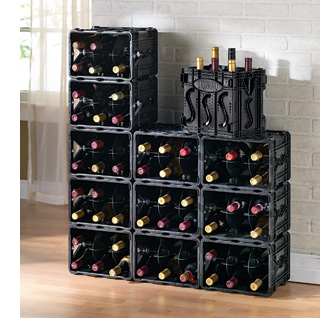
Oh your decorative plastic boxes are nice. $30 a piece you say? I think I’ll just keep the cardboard boxes the wine store gives me for free.
Do-it-yourself ($)

How do you like my new reading lamp? Worked for Tesla.
A basement storage closet was my obvious choice (chosen the first time I toured the house) because the basement is always fairly cool, the temperature doesn’t fluctuate too much, it sits at a nice humidity and it’s next to the future home of my studio (A guy’s gotta have hobbies). My problem with hiring someone to do it was that the space was fairly limited and I generally don’t like to pay people to do things I can do myself. My first problem with the options you can buy at a store is that 99% of them are all completely horizontal and I prefer the slight angling of the bottle because of science, yadda, yadda, oh, who am I kidding, it mainly just looks better*. Second, I think most of them are cheap !@#$ and I don’t like to pay…you get the idea. Therefore, I went with the third option. DIY.
Now, I did have plans to dig below the basement and create a subterranean cave for wine storage that would have looked like this:

The Batcave is in the back.
But a certain female and the City of Minneapolis wasn’t going to approve, so I opted to scale back the storage plans to what could fit into the closet. What did I use? I went to the Menards garden department and got two trellis fences and some stakes because that’s where all wine cellar DIY enthusiasts go. Here’s an itemized list for your shopping assistance.
Item List
- Decorative trellis fencing (2)
- Random stakes to cut into 7 inch pieces
- Screws
- Some unrelated cool thing you just saw sitting there at Menards that you totally weren’t going in there to get. It’s free with rebate, right?
I took one of the fences and cut the legs by 1 inch so when the bottle was placed between the normal sized fence and the shortened fence it would have a slight angle. Then I screwed the two fences together with the stakes that I had cut into 7 inch pieces (5 pieces did the trick). Then I put bottles in it after making sure it stood level on the ground. Ta da! 20 minutes and ~$40 depleted after beginning, I had created my own wine cellar storage that holds 37 bottles.

Don’t forget to anchor it to the wall!
The nice thing about this method is that I can expand once I figure out a larger spot to put it in by just repeating the process. And yes, I’m blocking the sun light streaming through that window now.
The simplified checklist for “proper” wine storage for the average citizen:
- A place with cool and stable temperature.
- A place free of lots of vibrations (even good ones).
- A place with little to no sunlight.
- A place that is humid enough so the cork doesn’t dry, but dry enough so mold doesn’t grow.
- Bottles should be stored on their side at a slight angle (Excepting the bubbly; that should be stored upright).
Go forth DIYers!
*There is actually a good reason for storing at a slight angle, however debatable. If you look at the surface area on the wine the bubble of air has when the bottle is directly on its side (bubble on the side of the bottle) compared to when the bottle is angled (bubble at the bottom corner of the bottle) you will notice just a bit less air touching the wine. The bottle aging process (oxidation) is supposed to then have a gentler approach. Will you notice when you pull out your bottle that has been sitting there for a year? Probably not, but you will be able to see the label better when you’re searching for it.
Posted in Education, Fun Facts | Tagged diy, wine cellar, wine storage | 6 Comments »

Actually made by witches.
I’ll forgo the usual format since I’m not pairing a wine with food this time.
For those that have asked me what my favorite wine is I usually give an annoying response telling you it depends on a lot of things like what I’m eating (if anything), the season, the weather, what socks I’m wearing (if any), etc. It’s very much like asking me what my favorite song is. Do you mean right now? Of all time? I have no idea what my favorite song of all time is; I just can’t commit to a decision like that. Right this second it’s anything remotely resembling a Radiohead song, but I think that’s only because of this brooding state I am in. I can’t even tell you what I’m brooding on, but I do know how I got here. And that brings me back to the wine.
It is a particularly rainy day here in Minneapolis with a bit of thunder on the side. In preparation for a wine presentation, I needed to have a picture of good wine smelling form. I generally try to stay away from stealing too much from the internet so I just took one of myself. As my prop, I opened up a bottle of Tannat/Syrah/Viognier blend from Uruguay that I have been wanting to try.

Pictured: perfect form
Tannat is one of those special grapes that France has been trying to distance itself from for some time because of its tendency to punch you in the face then push you into the darkest cave where you are shown all of your fears at once. Naturally, some other country sensed an opportunity to transform the beast just like the end of a Disney movie. That country was Uruguay, but instead of transfmogrifying it into a reformed prince, they just made it more of a beast. As far a deep red wines go, this one takes you to the abyss. No sooner had I had a sip of pure cedar, graphite, and cinnamon, with maybe a hint of some dark-as-midnight fruits in there, did I settle into some good brooding. It wasn’t even about anything. I had nothing to be pensive about. I would say Nebbiolo, the Italian champion of good brooding wines takes you to the edge of healthy emotions on a cold winter’s day and a glass full. Tannat, in a few sips, hangs you over the edge of that cliff on a mildly rainy day and then laughs about it.
Now for those that prefer to keep it light and cheery, you may be reading this thinking that you want to stay the hell away from anything that looks like Tannat. However, let me offer the counterpoint to your mindset. People tend to unconsciously show their emotions through what they wear, their body language, the foods they are eating, and a whole host of other expressions. It allows us to mull about in the emotion for a bit while it runs its course or while we are focused on a certain thought. Wine’s place is to provide enhancement to a certain experience which generally revolves around food. Given the intricate link between aroma and memory in our brains though, a few sniffs of a wine can bring a flood of memories, including emotions to the forefront. So a bright, cheery wine while you’re particularly moody, may come across as somewhat of an annoyance. On the flip side, some Tannat may seem aggravating if you’re in a bright and cheery mood. But, if it’s a rainy day and you’d like to ruminate on something, you’d best take a pour and take a trip down the rabbit hole.
Posted in Syrah/Shiraz, Tannat, Viognier | Tagged brooding, rainy day, syrah, tannat, viognier | Leave a Comment »
Have you missed the wine and food pairings? My apologies. They’ve missed you too!
Rating: 5/5
A coq au vin comprised of browned chicken (obviously) slow roasted over red potatoes, shallots, celery, carrots, leeks, with thyme, salt/pepper in a sultry shallow bath of broth and Burgundian white wine. Juices were reduced with some butter for sauce.
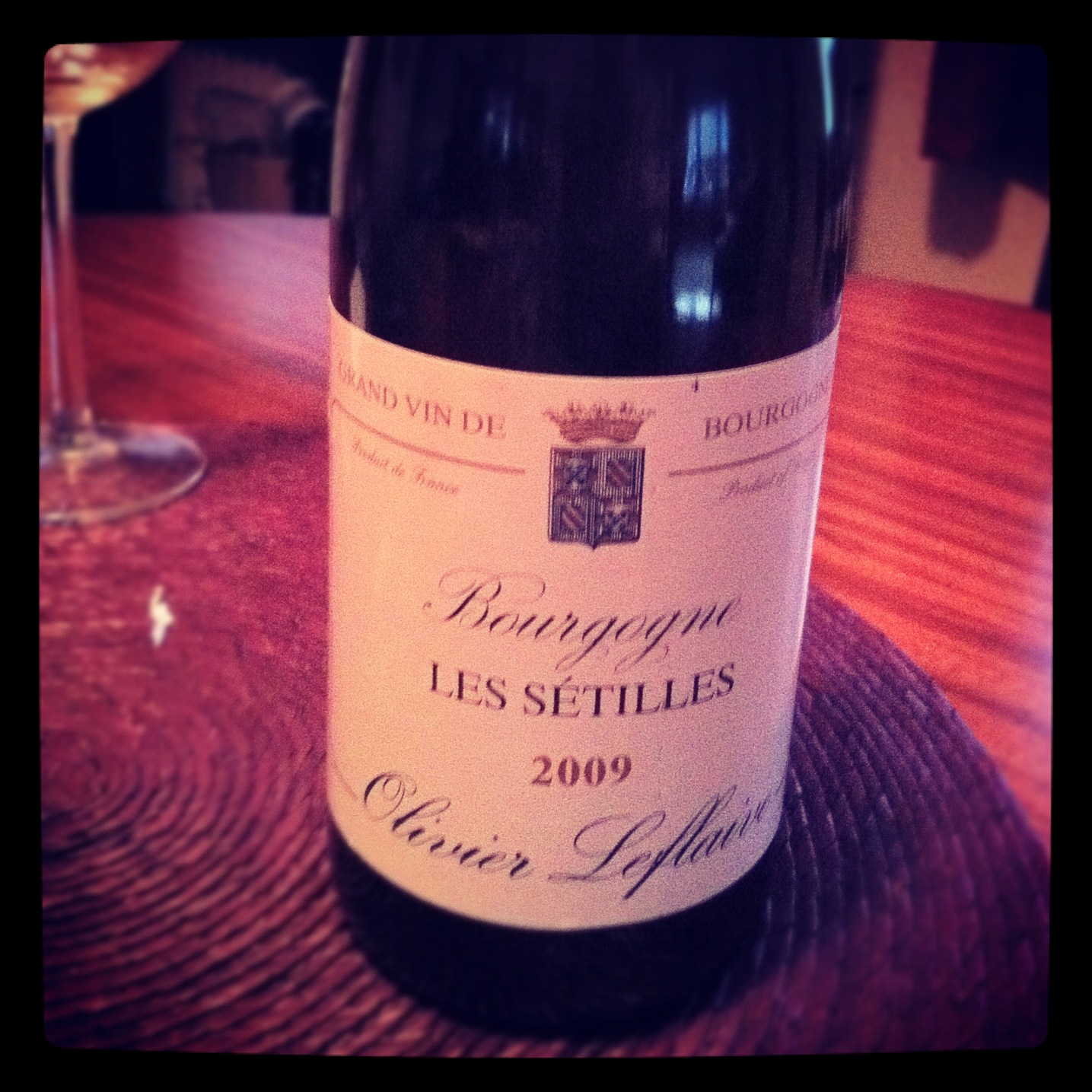
Wine: Oliver Leflaive Bourgogne Blanc “Les Setilles” 2009
 Notes:
Quick review: If it is white and from Burgundy, it’s a good bet that it’s Chardonnay. This particular one had a bit of oak, but nothing offsetting and it melded beautifully with the food. Providing some zip where there was a little fat, and providing some body, where the dish lay a little flat. This is one of those solid pairings that just hits home with me every time. You may not enjoy this sort of thing if you’re not the sort who enjoys delicious food and wine together, but if you come across a rainy and cool day this summer, give this a try. It will soothe your soul. If you instagram your experience, that may soothe your soul too, but I just got an ok picture of the wine bottle out of it.
Posted in Chardonnay | Tagged broth, burgundy, butter, carrots, celery, chardonnay, coq au vin blanc, Leeks, red potatoes, shallots, thyme | Leave a Comment »

Pictured: Rebellious youth. His mother is ashamed.
Recently, I was feeling particularly rebellious after listening to a somewhat inaccurate lecture on wine and food pairing. In the wine world, there are a lot of traditions that just aren’t based on actual facts. Most of them center around pairing wine with food and most of them attempt to tell you whether you’ll enjoy the experience or not. This is like someone telling you that if you go to a NASCAR race you will enjoy it without checking to see if that is your particular cup of tea or not. And if a tea metaphor is being used, NASCAR probably isn’t your thing, but I digress.
Now, as I’ve mentioned before, when I’m feeling particularly rebellious, I do what anyone would do: Sit down and set about proving whomever it is wrong, preferably while listening to some particularly loud music while wearing particularly unruly clothing and using a particularly #@!$ing uncouth vocabulary. In other words, I sat down and paired a blended (Zin and Cab Sauv) red wine from Sonoma with a bunch of things that the “experts” tell you not to, just to see what really happens. Admittedly, I’ve tried each of these combinations before which is why I was feeling rebellious, but never at the same time and never with writing utensil in hand.
The pairings were chosen based on the amount of times I’ve been told to never pair a red wine with them. Citrus fruit (I only had a lime, but a lemon works too), Soy Sauce, Vinegar, and Salt. For the vinegar and salt, I even selected two different types of each, just to cover all the bases. Then I compared six aspects of wine between the control (just tasting the wine by its lonesome) and each pairing. In this case, I’m using the terms “Fruit” to describe, well, the fruity flavors of a wine and “Bouquet” to describe the earthy, meaty, and generally not fruity characteristics. And yes, of course I put it into a table:

Conclusions:
Each one of these lowers the perception of tannin or astringency (that cotton ball feeling in your mouth). This is the main reason why the wine world rejects the pairing of red wine with any of these components. If you don’t mind the reduction in tannin though, or perhaps if you didn’t want it there in the first place, this practice makes perfect sense! However, the trade-off with most of these is that they also reduce the perception of the fruit characteristics. The two notable exceptions to this are the lime and the Kosher salt, which do a fine job of maintaining the fruit.
Other observations:
- Soy sauce is the only pairing that will enhance the non-fruit characteristics, mainly due to umami (savoriness) matching with the umami in the wine.
- Vinegar will increase the acid, no matter what kind it is.
- Iodized table salt sucks. It blows. It’s the pits.
Side Rant:
Salt should take bitterness out of things; that is its role in food. In this case though, it actually increased my perception of bitterness. Now, it didn’t increase the amount of bitter compounds, but it didn’t mitigate bitterness in the amounts that I had it (finger-tip’s worth) while slightly reducing everything else, thus increasing the perception of bitterness. I see why people feel the need to douse all of their meals with this stuff. It doesn’t work in small quantities. Hypertensive Americans should revolt against iodized salt…or just use Kosher salt instead.
P.S. The science world has actually proven that pairing a big Cabernet Sauvignon with a steak works because of the salt the seasons the steak and not because the tannins are latching on to the fat. Read Molecular Gastronomy if you’re into geeky food science happenings.
Posted in Cabernet Sauvignon, Education, Fun Facts, Zinfandel | Tagged balsamic, citrus, iodized, kosher, lime, red wine, salt, soy sauce, vinegar, wine and food pairing, wine science | 3 Comments »

Recently I attended the Cold Climate Conference in downtown St. Paul to get a grip on what is going on in the Minnesota wine scene. Now, I know I just blew your mind with the fact that there is a local wine scene, but let me blow it again: it is worth checking out. This article I wrote for the Downtown Journal about the CCC is worth checking out too!
The Midwest has struggled for years ( numerous decades if you want to talk about Missouri) on how to grow grapes that are fit for wine. To be quite honest, for the most part, it’s been a bit of a failure. It isn’t that the people attempting this are just bad at growing grapes and making wine from them. You get those people in “wine country” as well. No, it really boils down to the fact that in Minnesota, or Iowa, or Michigan, or Wisconsin, we have really cold winters.
Vitis Vinifera is the species of vine that 99.99% of all drinkable wine is made from. While the positives of this species abound in terms of the wines it produces, the major downside for those of us in the midwest is that these vines just wouldn’t survive the winter if we planted them here (which we have) unless we did things like bury them through the cold months (which we have tried).
Well, because this is America. And we’re American. We don’t take kindly to being told we can’t do things. Therefore, some enterprising folks, a lot of which work for the University of Minnesota, have been developing hybrids of Vitis Vinifera and species like Vitis Riparia, which is native to Minnesota in hopes that we can take the best wine qualities from vinifera and seamlessly meld them with the cold hearty capabilities of riparia. Quite the project.
Therefore, you may see varietals such as La Crescent, Brianna, Edelweiss, Frontenac Gris, Frontenac, and Marquette on the local bottles instead of the words that you’ve just begun to know how to pronounce, but the rest of the world is familiar with. I don’t know how long it will be until these varietals are seen on shelves outside of the midwest, but my guess is that it will take awhile. However, don’t let that stop you from tasting the local fare. After tasting a good sampling of local wines, I can certainly tell you there is promise. There were even a few wines that I might actually enjoy buying a bottle of. I think I’m developing a soft spot for Marquette, but don’t let me impose my preferences on you. Instead, let me impose rules to guide you along the way.
Some general rules for your Midwest wine excursion:
- If all of their whites are described as “sweet”, kindly run away. Unless of course, you are into that sort of thing, then drink up, me hearties!
- Everybody has a dessert wine and everyone thinks there dessert wine is special. It is special…just like everyone else’s. Would you turn down a chocolate chip cookie? Nope. Would you call it a culinary masterpiece? Nope.
- The famous wine regions of the world have been making wine for thousands of years at a basic level and hundreds of years as a practiced craft. Frontenac has been around for 10 years, Marquette for 3.
- On a similar note, we know that the experience we get when we drink wines from a certain region will be similar regardless of the wine maker as long as it’s of a certain quality. The Midwest hasn’t come to agreement yet as to what the wines should be like. In fact, we haven’t even decided what regions we really have. Don’t expect homogeneity yet. Ask yourself when you drink the wine whether it expresses where it comes from or not. Promote the ones that do.
- And of course, just go drink wine and have a wonderful time with people. Enjoy the experience!
Last, I have a little assignment for you. I’ve found through my tastings that most people confuse the sensation of acidity for that of sweetness. I have no idea why this confusion exists, although I do have a few theories (here’s looking at you food industry!). Generally, I’ll have them taste an acidic white wine that is entirely dry and they’ll tell me they like it because it’s a little sweet. You can note acidity by the amount of saliva rushing into your mouth after you swallow. Now, there are different types of acidity, but we can get into that later, for now just note if you’re really talking about sugar sweet or “sweet” as in acidic like a tart green apple. Midwest wine makers have been told by local people that they like “sweet” wines. There is even horrible, horrible marketing “research” that says these things. So if you really like crisply acidic white wines, don’t tell them you like sweet ones. They’ll make syrupy sweet wines for you if you say that and the myth will continue.
Posted in Education, Fun Facts, Vineyards/Wineries | 3 Comments »
I know, I know, it’s taken me forever to get this up! Hopefully, this conclusion to my exploration of the sushi and wine experience makes up for trying your patience. I promised charts. I promised science. I promised that you’d be able to comfortably pick out what wine you want for the experience you want when having sushi. Ladies and Gentlemen, I deliver all of those things in this riveting end point to your wine and sushi voyage. For the very impatient (aka lazy bums, slackers, non-geeks), please scroll to the chart at the bottom to get the answers without having to learn.
Where We Left Off…
In Part 1, we did a review of the existing “literature”. By that, I mean we Googled the heck out of pairing wine with sushi and came up with a whole lot of nothing useable. Preferences were listed aplenty, but no guides existed to help you in the sushi restaurant.
In Part 2, we reviewed the components of wine and sushi and laid out some plausible theories as to what kinds of interactions could go down when mixing and matching. Here I brought in the insight of Tim Hanni, MW to get his take on what actually happens when wine and food are mixed in our noses, our mouths and our brains. We also discussed some of the existing claims out there and Tim happily took down a lot of the nonsense that has been floating around. At the conclusion I delivered 4 specific interactions that really affect the sushi and wine experience. To repeat and save you the trouble of clicking the link and having to read:
- When a flavor component of the food is similar to that in the wine, the experience of that flavor is enhanced. This is called flavor matching.
- The perception of alcohol will increase when paired with sweet, umami-tasting or spicy foods.
- The perception of spiciness will decrease when paired to a wine with more acidity.
- Tannins will noticeably diminish when they encounter salt (soy sauce), citric acid (lemon juice) or vinegar (pickled ginger).
Some More Science
In doing some more research on flavor components, I came across a fascinating article in Nature entitled Flavor Network and the Principles of Food Pairing. When you mix wine with food, it’s really an extension of the existing ingredients that are already in the dish. We have our preferences as to which herbs and spices work in which dishes, so we should have our preferences as to which wines work with which dishes too. In the article they broke down all of the components of food down to the compound level. You see, it’s the combination of certain compounds that we interpret as flavor and aroma. Then they ran through various recipe sites on-line and compared which components always showed up together and which ones did not. The most interesting outcome of this study was that they found in Western cooking, we generally like to put together ingredients that share compounds. In Eastern cooking, we generally like to put together ingredients that do not share compounds. Now think back to the first interaction I listed. If two items match up on flavor/aroma compounds, then that flavor/aroma will be enhanced. If two items don’t match up on the compounds, then nothing is really enhanced, but things are made a bit more complex. Trouble wrapping your head around that one? Thankfully, the authors of the paper came up with an excellent chart to show which ingredients share components (closer together) and which ones have differing components (farther away). Definitely click on it to get the larger view. 
To associate this with our sushi and wine pairing, this means that if we have a wine that shares a lot of compounds with the components in the sushi, we are going to get an enhancement of that particular flavor or aroma. The wines that do this are going to typically be whites since they carry a lot of the green, tropical fruit, floral, and minerally components. If we have a wine that diverges from the compounds of the sushi components, we are going get a more complex sensation of taste. This will happen with the vast majority of reds with their more earthy, red fruit, and black fruit components. I generally like to think of this concept in terms of sound waves because they do the same thing. A sound wave is enhanced if the same wave gets overlaid on to it and the sound wave is neutralized if the exact opposite wave is laid on top of it. [As a side note, the latter method is essentially how noise cancellation works.] [As a side note to the side note, I think the idea of creating flavor or aroma component “chords” is something very real and needs to be explored] Therefore, the first decision you have to make is whether you want an enhancement of certain components with your wine and sushi pairing or if you want to add complexity to your experience. Posting the common aroma descriptors of each varietal would make this post a bit lengthy, so I’ve simplified the concept in the chart at the end.
The second decision you have to make is how much of a wasabi kick you are looking to get. If you’re eating sushi the “proper” way, you should only have a tiny dab with your bite (if any at all), but some people have been known to take a chunk just to get that brain burn feeling. Again, a reminder that the wasabi you are having is really horseradish, mustard and food coloring and not actual wasabi, but the effect is generally the same. One way to control the amount of kick is to simply control the amount of wasabi you are ingesting at a time. However, one can neutralize some of the effects of the spiciness by taking a swig of wine that has some noticeable acid in it. This is nice for those who are not so daring to swallow a chunk of wasabi outright, but might enjoy the pepperiness that it brings. The exact proportions will differ by person, but it’s certain that if you take a lot of wasabi in at once, no amount of acid will diffuse that shooting burn you’ll get through your brain. It’s the in between area that there is room to play. On the flip side of that, if you have a wine with more pronounced alcohol content, that kick may be heightened depending on your level of sensitivity. The more tolerant taster who doesn’t noticed higher alcohol content in wines as much (as a burning sensation in the back of your throat near the nasal cavity) may be more tolerant of spicy foods to begin with. The more sensitive taster should take note though. For those who like to live on the edge, take something 100 proof alongside a big chunk of wasabi. I’m sure it will be a trip you won’t forget. If anyone wants to create a shot based on that, all I ask is that you send a small portion of the revenue from all of your “I survived….” merchandise my way.
Last, we consider the tannin factor. That cotton feeling you get wrapping around your tongue generally with red wines. This was a big point of contention on the internet as the red wine purists couldn’t understand why their tannins had disappeared and the rest of the people didn’t want them there in the first place. But are we just restricted to white wines or red wines sans tannins when eating sushi? No! You can have the wine you want with the experience you want, but you may need to take steps to get it that way. Let’s remember that the sensation of tannin decreases significantly when you add in citric acid, vinegar or salt. We can get citric acid from a lemon slice, vinegar from pickled ginger and salt from soy sauce while we’re eating sushi. Use these as your tools. You want all the tannin goodness your favorite wine can provide? Stay away from dunking your bite of sushi into soy sauce; forgo the slice of pickled ginger in between bites. Your tannins will be there every step of the way. What’s that? You inconsiderately ordered a bottle of tannic red wine without asking the people you are with what they want and they don’t want any tannin at all? Well they’ll be resigned to getting a bit more soy sauce on each bite than they’re used to; having a slice of pickled ginger in between bites; or maybe just squeezing a bit of lemon over everything. The moderates can find their ideal balance somewhere in between with a little trial and error using the tools available.
Now, I wouldn’t have gone through all this work without trying these theories out on unknowing participants. That’s not my style. An event was put together with 15 people to verify the effects of these interactions with 4 different wines and an assorted collection of sushi. Was it scientific? Not remotely. Did it successfully verify that people who just like wine and also like sushi can use this information to identify what wines they like best with sushi? Absolutely. We used all of the common ingredients found in sushi restaurants in Minneapolis and tasted four wines throughout the night: Grüner Veltliner, Viognier, Carmenere, Shiraz. Keeping in mind that the impression my internet searching left me with was that people shied away from reds when eating sushi, it was a fun surprise to discover that with the tools I had given the group, the overall favorite pairing was the Shiraz.
The key, as with just about everything, is balance. More importantly, it’s knowing what you are balancing. Three questions need to be asked when you sit down to sushi and you’re deciding what wine you want.
- How much wasabi kick do I want?
- How much tannin do I want to be noticeable?
- Do I want flavor enhancement or flavor complexity?
Charts!

Add acid to manage excessive wasabi kick

Alcohol will increase the wasabi kick moderately

Finally, here is the chart that was given to the willing subjects. The wines listed are all of those available at the various sushi restaurants in Minneapolis and St. Paul. Notice how it guides you toward achieving balance through trade offs. Happy pairing!

Posted in Carmenere, Education, Fun Facts, Gruner Veltliner, Syrah/Shiraz, Viognier | Tagged acid, alcohol, aroma compounds, carmenere, flavor compounds, gruner veltliner, gruv, shiraz, sushi, syrah, tannin, viognier, wasabi, wine, wine science | 2 Comments »
There’s a common adage that floats around when people discuss viticulture that the vines must be stressed during the season to produce wonderful grapes for the harvest. Those of us that know little about horticulture, take a sip of wine so we don’t have to talk, nod politely and associate this with the romanticism or mysticism surrounding wine. I’ve come to discover that most of the people who state this adage emphatically, have no idea what they are actually talking about. When you press these people for more on the topic, they mumble things about poor soil quality, restricting water and maybe add the word terroir randomly before quickly changing the subject (worked for me!). To relieve the suspense up front, it isn’t that this old saying is wrong, it is very right. But I try not to go around saying things when I don’t know what they mean.
While the title of this post may seem a bit cheeky, I promise I’m not misleading you (too much anyway). Without further delay to your knowledge gratification, let’s get down to the dirty business of stressing the vines. I’ll try not to let too much hot vine on vine action get in the way of what I’m trying to say.
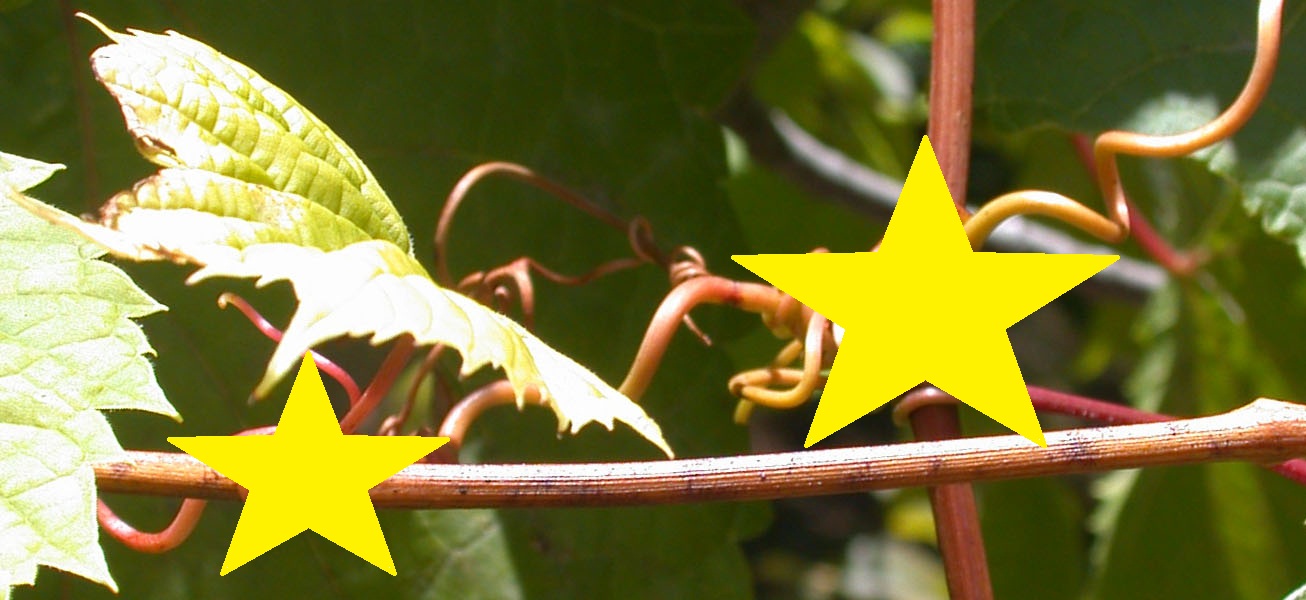
Bow Bow Chicka Wow Wow. Oh baby! Too late!
Plants generally reproduce in two ways: one is called vegetative reproduction which can be thought of as plant growth or self-replication and the other is good ol’ sexual reproduction. Concerning our beloved grape vines, vegetative reproduction is when the vine puts the energy it is generating into growing the vine and its roots. Sexual reproduction is where the vine puts the energy into making seeds so it can further its genetic line elsewhere. Jamie Goode puts is wonderfully in his Science of Wine book:
Generally (and simplistically) speaking, if conditions are good and a plant is doing well, then, if it can, it opts for vegetative reproduction or just grows larger – after all, there’s clearly a good match between the plant genes and the environment and it wants to keep things that way. On the other hand, if conditions are bad, plants will more often choose to reproduce sexually (the “I’m outta here” option), which requires fruit production.
Let’s talk about the Birds and the Bees, shall we? A vine may reach a certain point in its life where it gets that “funny feeling”. Of course, in this instance, the feeling is the realization that the vine’s current home, terroir if you will, just isn’t working out and it needs to sow its seeds elsewhere (literally speaking) to continue the genetic line. Through the course of evolution, the vine has developed symbiotic relationships with certain insects (i.e. bees) as well as animals (mostly birds). Never one to go it alone (seriously, they’re so dependent), when the vine decides it needs to reproduce, it grows flowers which signal the bees to do their thing on itself or with other vines. Come to think of it though, domestic vines are mostly hermaphrodites so I guess there is really just a lot of “self-pollination” going on.
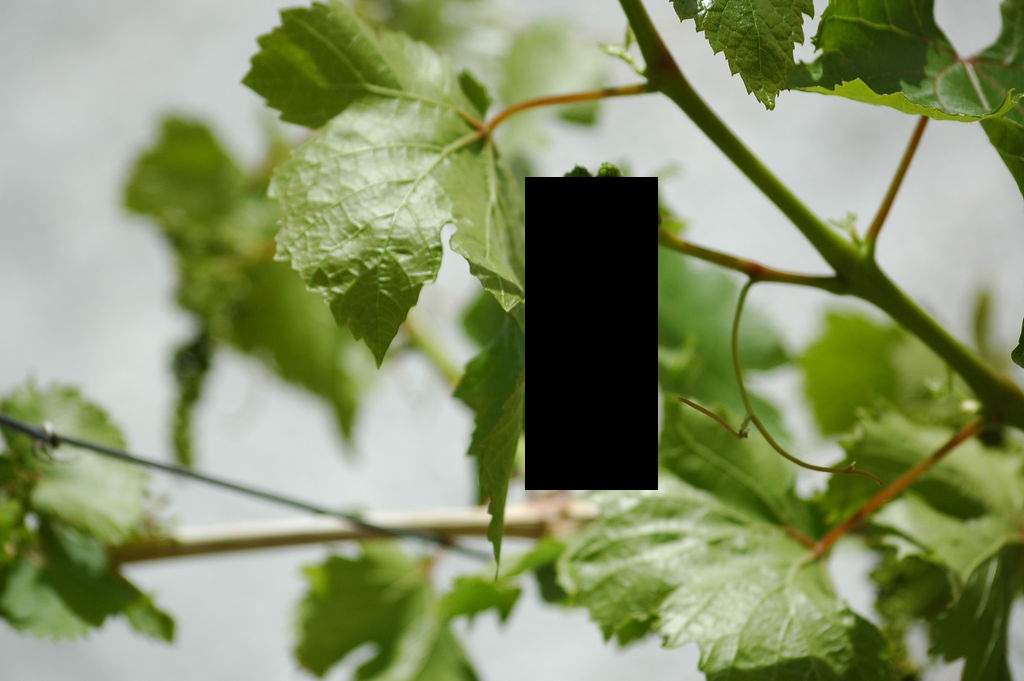
Don't come in! I'm...um...changing.
After the bees do their part and the grapes start to grow, the vine cues the birds. [Birds enter, stage right and all aflutter] The “cue” in this case is when the grapes turn from small and hard grapes, to fat and juicy ones. In the viticulture world, they call this point veraison. Now, grape growers wait a bit after this to pick the grapes because they develop a little more after this point, but this is the dinner bell for the birds to swoop down and eat the calorie-filled tasty treats while swallowing the seeds whole. As one would assume, birds and farmers generally do not get a long very well. I don’t need to describe the seed extraction process from the bird in detail, but the hope is that the bird does that elsewhere and in a lovely new home for a future vine.

Thank you, internet.
Which brings us back to stressing the vines. For the best possible grapes, we need a good strong vine that puts a lot of energy into producing fruit. If everything is dandy in the vine’s world, it won’t feel the need to spread its seeds which means little or no fruit. On the other hand, if things are absolutely horrible, the vine won’t spend anytime doing personal development, it will just be in eject mode which means a weak vine. Therefore, you have to give your vine everything it wants (adequate amounts of water and sunlight and maybe some supplemental minerals) to get it nice and strong and then “stress” it or deny it some of its needs just enough to get it to feel the need to produce fruit.
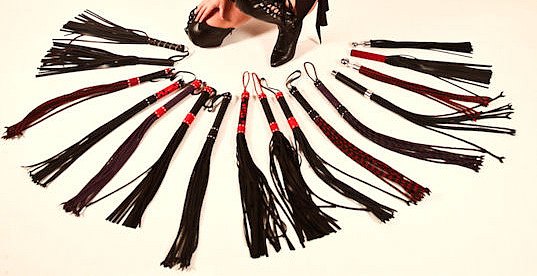
Various examples of a commonly used vine "stressing" apparatus.
How you do that is both an art and a science, depends a lot on the terroir (geography, climate, weather, etc.) and what grapes you are growing. Because the weather changes every year, there is a level of unpredictability in what the vine will need each year to get to that balance of ideal vine and fruit growth. A great season weather-wise will do most of the work, but this doesn’t always happen. This is why there is much ado about vintages, but that is a subject for another post.
OK, so this post really should have been titled: “Stressing the Vines” Is All About Sex(ual Reproduction)! But hopefully I threw in enough hot vine on vine action to keep you satisfied. Whatever you do with this information, please, please, pleeeeaaase do not tell those vines that we are stealing their children and using them to make a heady beverage. Let them think their seeds are settling in greener pastures and leading a better life than they ever could have had. Perhaps, it is best to keep them in the dark about this one. For our sake’s anyway. They may end up coming after ours.

Posted in Education, Fun Facts, Research | Tagged grape growing, plant reproduction, stressing the vine, vine propogation, vine stressing, viticulture, wine | Leave a Comment »
Rating: 4/5
Dal from red lentils and a biryani spice blend over rice and delivered on some homemade naan. A side of Yogurt Raita composed of yogurt, freshly chopped mint leaves, cucumber and grated orange peel topped everything off.
Wines: Chateau L’Aiguillette Muscadet Sever et Maine 2009 and Yalumba Muscat Museum Reserve Dessert Wine
 Notes:
After having such a carnivorous meal the night before, I decided to go with the vegetarian option the next night (a true Omnivore at heart!). The Indian dish of Dal is a fantastic option, but by no means is it a “light” option. Before we get into the details, let me first address one point: I did not choose an Indian wine for this meal. The old adage of “What grows together, goes together.” does have some validity, but there is always one big assumption being made. That assumption is that wine is and has been part of the culinary culture of that region for quite some time. Regions tend to develop their wines over their history based on the foods that are being eaten. In fact, it’s one of the primary factors in developing a distinct list of characteristics of which a varietal should display. When you travel through wine country and eat and drink the local fare, you’re sampling the result of a very long-term trial and error process. It’s not that the wine and food pairings that you are experiencing are the only ways to pair the items or even the best, but they are a tried and true method of two co-developed components. At a minimum, it’s probably the least risky pairing you can find.
On the flip side, let’s take a region that has only been producing wine and using it in their meals for a very short period of time; say, those in India. They have two major burdens to overcome. One is that the “standards” of what certain varietals should be like are developed by cultures with greatly different culinary tastes. For instance western cooking tends to pair ingredients with similar flavor compounds that amplify each other while eastern cooking tends to pair ingredients with differing flavor compounds. The second is that they haven’t spent as much time co-developing their wine and food (the long trial and error process) so they haven’t had time to work out the kinks yet. For Indian wine, my minimal exploration hasn’t led to anything of good quality or enjoyableness and I personally think this has a lot to do with their latitudinal position on earth (i.e. not between 30 and 50). However, I will continue to explore it much more thoroughly before I make any final judgements. But back to the wine and food experience!
I originally wanted a dry Muscat with some display of orange peel on the nose and palate for this to play with the hints in the Raita, but sadly a dry Muscat proved difficult to find. Therefore, I opted for the Muscadet from the Server et Maine appellation in the Loire Valley, France. Muscadet, in general, isn’t terribly remarkable. In Server et Maine, they let the lees, the solid sediment created after fermentation sit on the wine for awhile to impart quite a bit more character into the wine. In addition to the salt-air-minerality and light citrus, the wine has a yeasty, almost creamy component to it as well. If you see “Sur Lie” on a French bottle, this is what they have done. And it did work with the dal. I could have used a bit more citrus, some sort of floral or blossom component to play with the orange peel and mint in the Raita and the body was enough to not get lost, but could have been a bit more substantive to be a perfect pairing. The mineral notes added an interesting queue to the biryani spices (cinnamon, clove, cumin, coriander, cardamom) which I rather enjoyed though. While the yeasty/creaminess amplified the rice and yogurt flavors, the minerality was what added a layer of curious depth.
In a fit of determination and stubbornness, I had also picked up a bottle of Yalumba’s dessert wine Muscat. Orange peel, galore. This dessert Muscat from Barossa is fabulous as an aperitif or could go with a wide-number of light appetizer or dessert options. The sweetness was obviously way too much for this meal, but in teeny-tiny sips, alternated with the Muscadet, it was fun. For an analogy, I would compare my pairings in this meal to alternating something cold and something hot to get the perfect temperature (or switching between Papa Bear’s and Mama Bear’s porridge instead of stealing porridge from a Baby Bear). While I wouldn’t recommend doing a co-pairing at a meal for someone you are trying to impress since they’ll just assume you are trying to get them drunk, it is a fun experiment to attempt.
Posted in Muscadet, Muscat | Tagged Chateau L'Aiguillette, cucumber, dal, dessert wine, lentils, loire valley, mint, Muscadet, muscat, naan, orange peel, raita, rice, sever et maine, sur lie, yalumba, yogurt | Leave a Comment »
Rating: 5/5
A 1lb New York Strip steak cooked for 3hrs Sous Vide in butter, shallots and thyme then browned on the skillet. Side of (who cares really when you have a piece of meat that good?) sauteed kale and mushrooms.
Wine: Dusted Valley Stained Tooth Syrah 2009
 Notes:
There are many ways to cook a steak, but only a small few if you want it to be delicious. My preferred method is to use a combination of iron skillet and in-oven cooking. However, if you have the time, I recommend venturing into sous vide territory. The expression literally means ‘under vaccuum’ and is generally how a lot of of high-end restaurants do their exquisite pieces of meat. You seal the meat up with a fat (butter in this case) and some assorted herbs and spices to your liking, remove all air and then submerge the package into water that is the exact temperature that you want the meat done at for however long it takes to cook the meat (An hour per inch thickness at minimum is a good rule of thumb, but you can let it sit in there for as long as you want). Don’t forget to reserve the juices for dipping after! Now, the high-end restaurants have very expensive contraptions that make this process insanely easy, but with a little McGuyver-ing you can do it with a heavy duty freezer back, a big pot and a temperature probe. There are plenty of on-line resources for this one so have at it and for a special treat, try poaching an egg sous vide style. But back to the wine and food experience!
The steak was cooked to a medium-rare level which is how I like them and was oh-so-tender with a dash of finishing salt just before I dove into it. The wine was a big, fruit-forward Syrah from the lovely folks at Dusted Valley with plenty of tannin and acid which was all beginning to come together nicely here at the beginning of 2012. I’ve been loving the Washington state Syrahs these days and this is no exception. The base of this wine is Syrah and Viognier, the blend that originated and was made popular by Northern Rhone. This blend is also doing spectacularly down in Aussie-land as I’ve featured before. However, Dusted Valley takes a quick trip down to Southern Rhone and blend in some small amounts of Grenache and Counoise which gives it a bit more depth. Any remaining tannin that would have stuck out was absolved by the light salt application and you are left with are the dark fruits and a bit of earthiness working with the mushrooms. Simple meal, wonderful results. For the steak lover, this is pretty much the tops.
Posted in Syrah/Shiraz | Tagged columbia valley, kale, mushrooms, new york strip, sous vide, steak, syrah | 1 Comment »
 Aaron Berdofe's Wine and Food Experience