Man, it’s been awhile since I’ve posted! I’ve been busy…drinking wine and stuff. OK, I really can’t come up with a good excuse. To make up for my prolonged absence, I am giving you a crazy-awesome wine and food experience. I even have multiple pictures just to back up all the hyperbole of the last sentence. Let’s get to the good stuff!
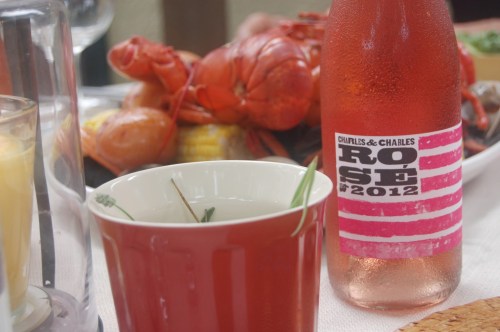
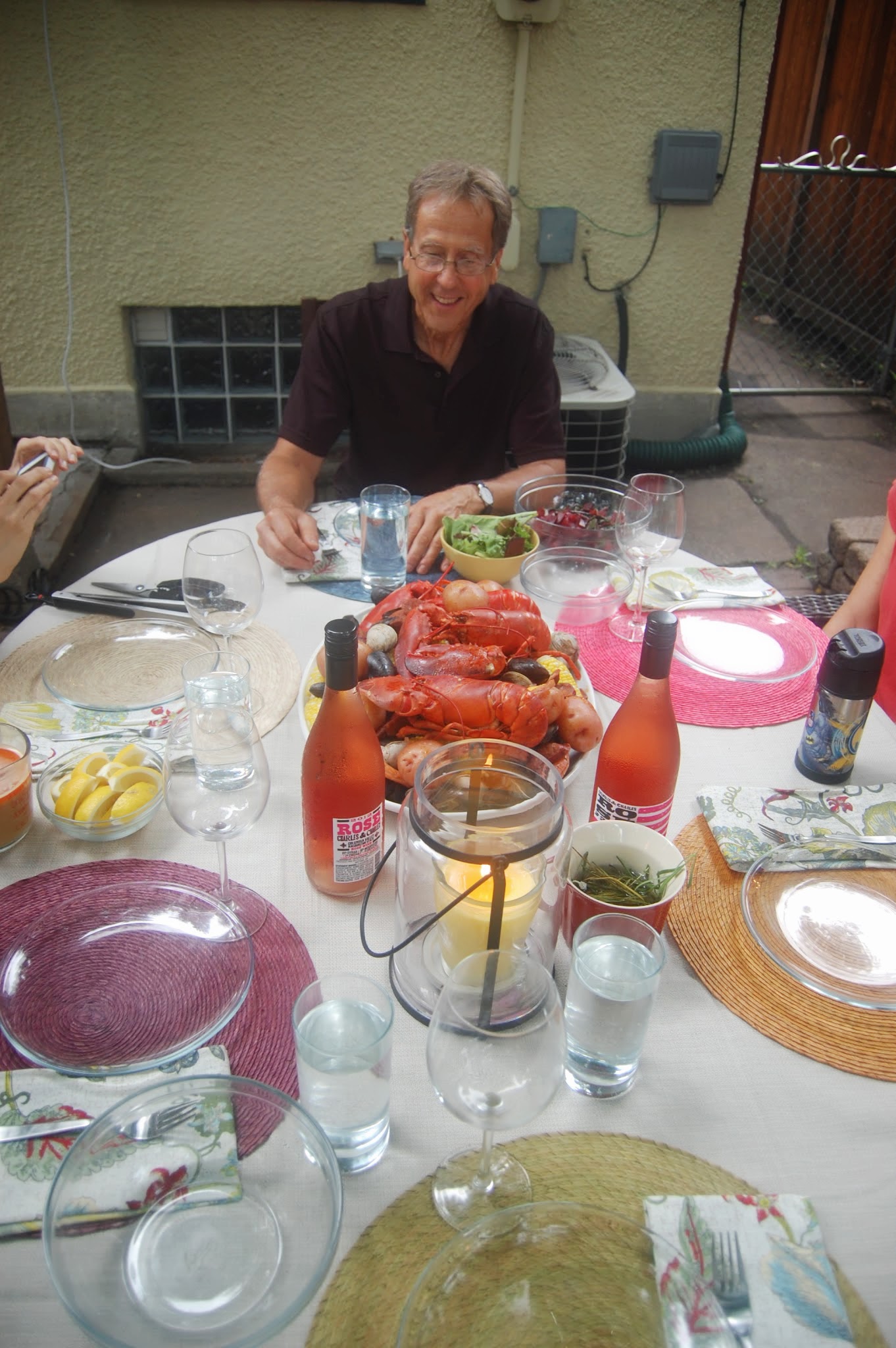
Seafood medley of clams, mussels, lobsters, and shrimp accompanied by red potatoes, chorizo, and ears of corn. Cooking juices loaded up with butter for dipping.
Wine: Charles & Charles Rosé 2012
Yes, yes, yes, the food and the wine were absolutely fantastic. All of it was cooked in single pot, and I don’t want any grief from East Coasters about that fact that I did my clambake in Minneapolis! The dry rosé from Washington had a great sense of minerality that worked well with the seafood and quite a bit of bright fruit to add a nice layer of texture on top of the meal. Overall, this was a great wine and food pairing, but when it comes to the experience of the meal, there’s always so much more involved.
It just so happened for me that my craving to have a clambake this year was given the perfect opportunity by my father being born a certain number of years ago (His secret is safe with me). Fortunately, the rain held out and we were able to enjoy the great outdoors in the city while stuffing ourselves silly with delicious seafood and washing it down with solid wine. As a little sensory bonus I clipped some rosemary, lemon thyme, and lavender from my garden and poured some hot water over them (essentially just making herbal tea) to add a little headiness to the air. It was fun, it was messy, it was an adventure. This is truly one of those events that I think everyone simply must have annually. I don’t even care what you’re celebrating. Just find a great meal, get some great wine, and then put some effort into it!
The best part about wine and food is that it gives an event something to focus around. This shared social experience of enjoyment is, in my mind, one of the finest things in life. One might credit the amount of wine consumed, but I’m guessing it’s the act of sharing something enjoyable that brings people closer together during these nights. I would add that it’s of extra benefit to share something enjoyable that is also new.
I could probably go on a rant about how we as an American society are not spending enough time sitting and enjoying meals together, but I think we’re all acutely aware of that message. Instead, I will say this: wine and food are an integral part of the human connection. The experience is also an important opportunity for adults to show children how to drink alcohol responsibly with food. So the next time you think about planning a meal go ahead and decide to cook something you think is fancy and share a bottle of wine over it. Just the little bit of extra effort in thinking about it will pay off in dividends.
The box tinkled as I lifted it, catching the ear of the Riedel (pronounced “REED-uhl”) sales rep. “That’s not good…” No, it certainly was not good. A hundred or so boxes later, the damage was totaled up. Around 80% of the boxes containing 4 different Riedel wine glasses held at least 1 broken glass; generally the Chardonnay glass. As we carefully separated out the broken glasses from those still intact, the presenter of the tasting session racked her brain to come up with Plan B. The rest of us furiously, yet carefully wiped down the remaining glasses to a sparkle. I, only utilizing nine fingers, successfully avoiding getting blood from the tenth on the glasses like a true professional. It’d probably be more understandable if I had cut myself on one of the broken shards, but no, I had received a paper cut from one of the cardboard boxes. Yet even with one glass down, the folks from Riedel made their pitch to a large group of conference goers as to why each varietal of wine deserves to be sipped from it’s own specialized glass.
Their reasoning behind having a multitude of glasses is this: each varietal has its own “signature” aromatic profile and they have designed glasses to highlight this. Oddly, I had previously thought that they had just wanted to diversify their product line and increase sales. To demonstrate, they pour out a single wine into it’s “appropriate” glass and then have you pour the wine into the other glasses to compare. They also acquire a “joker” glass, in this case, the squatty wine glass the hotel’s banquet service utilizes to act as a control. Think of the wine glass you get at a wedding.
Halfway through the tasting (or smelling as it were) the sales rep asked if anyone was not convinced yet. The lone enologist in the room raised her hand. Since I was assisting the event I merely whispered my support to her discreetly. Truth is, I’m not convinced either.
There are a few things about their pitch that just don’t work for me. First and foremost is that they pour a wine into it’s assigned glass and tell you that what you smell is exactly how that wine should smell. After this, they tell you to pour the wine into another glass and point out how it’s different, which they then define as worse. This is called Priming in the advertising/marketing world and while effective, I wouldn’t call it the most honest. Second, they compare their glasses against the worst glass possible. Third, they only focus on aroma, which to me isn’t the whole picture when choosing your glass.
However, I wanted to give this experiment a fair test. What would happen if I removed all of the factors that were designed to convince me that the Riedel glasses were not only superior, but variety/style specific ones were needed. Naturally, I went home and set up another wine-related experiment. Now, I have a wider variety of glasses than the average duck:
Bucking my habit of minimalism.
From left to right: Flute purchased from Crate and Barrel, Riedel Sauvignon Blanc glass, Riedel Burgundy glass, Ikea wine glass ($2.99!), Riedel Cabernet Franc glass, Red wide-bowled glass purchased from Crate and Barrel.
Unlike the Riedel experiment, I opened a bottle of Sonoma Zinfandel and poured the equivalent amount into each glass. As I went down the line smelling them there were again differences, but I honestly couldn’t put a preference on which glass I would go with solely based on aroma.
Here’s the deal, when you pour wine into a glass, the aromatic compounds that eventually get to our nose get kicked up into the air of the glass. Various compounds have different densities so they settle at different levels in the air inside the glass. Your fruity esters will be up top and some of the more earthy aromas will settle more towards the bottom. This density thing is generally why wine people swirl their glasses like pretentious pricks. It mixes the compounds of different densities and puts them in the air above the liquid for your olfactory pleasure. Think of it as an aroma emulsion.
Sommeliers across the world generally deal with three glasses. A white wine glass which is taller than it is wide, a red wine glass that has a wider bowl than the white wine glass, and a glass for sparkling wine which is thin and tall. According to standards committees (the ISO) the best glass for tasting is one that is half as wide as it is tall. Regardless of which glass, the rim should always be a little more narrow than the bowl. Those are the few specifications that the industry agrees that work.
What I have found is that the wider the bowl of the glass, the faster the volatile chemicals of the wine (the aromas) will dissipate. For reds that seem “tight”, this is good. More oxygen hits the wine which releases more parts of the aroma. This is also why people want to decant wines, leave the bottle open for a few hours before serving, or put the wine in a blender. Oxygen releases aroma. BUT, the general trend for American wine drinkers is to be overwhelmed by the aromas. Therefore, depending on how fast you drink your wine, you want a bowl with a size that matches your appetite for wine. It should be noted that red wines contain a higher amount of polyphenols in them which are anti-oxidants so that’s why glasses for red wines have historically had wider bowls than for whites. Therefore, your enjoyment of a tannic red wine might not be different when had in a white wine glass as long as you drank it over a period of a few hours. On the flip side, you might find that the aromas of most white wines diminish too quickly when served in an airy glass.
But back to Riedel. The aroma difference between the Riedel Cabernet Franc glass and my closest non-Riedel glass (The Ikea one) was close to nil. The minimal differences in the shape of the glass really did not make a difference. However, the Riedel sales guy left out a few factors which greatly add to the experience of drinking wine, that of the size (and direction) of the lip of the glass, the balance of the glass overall, and the quality of the glass.
Riedel Cab Franc (Left), Ikea (Right)
A thin lip that points up or slightly out is less obtrusive to putting wine into your mouth (bonus). A balanced glass will let you roll the stem between your fingers as you gaze into its mystical depths (romantic bonus). And there is a positive correlation between the quality of the glass and the quality of tone you get when you clink two glasses together gently and then put one up to each of your ears (musical bonus). In other words, it adds to the experience overall. Admittedly, the Ikea glass fails at the musicality aspect since it’s cheap glass and if I’m being honest, I’ll generally reach for the Riedel Cabernet Franc or Burgundy glass. Why? Because they’re damn good quality glasses. It really has nothing to do with their intent to be used with certain varieties or styles.
To end this post, I will leave you with what I think its the worst possible wine glass ever made. I’m speaking about the globe glass, which you may find in nearly every mid-scale Italian restaurant. It makes you feel like you’re drinking upside down when the glass is full and when it’s nearly empty you have to turn upside down, just to get the last few sips.
Great river-view patio. Worst wine glass ever.
So there you have it. Now let me go find the next trendy Minneapolis cafe that feels the need to serve wine in tiny tumblers.
Another example of how loquaciousness would get the best of me if I wrote tasting notes.
It was mid-morning by the time we set out on horseback with the smoke of the morning fire still tussling our clothes. Open plains were spreading before us, rising into the mountain range beyond as the sun began to beat down through the painted clouds that dotted the sky. The day wasn’t particularly hot though as the fall of the autumn leaves was approaching; just enough to warm your back and easily fight off the overnight chill. With the sizzle of a match, one of the caballeros lit a rich cigar. The aromas encapsulated my entire olfactory experience briefly before giving way to the more delicate scents of the dark fruited berries and wild thyme lining the path. In the dryness, the horses’ hooves kicked up the earth, casting a gritty and somewhat muted tone on our surroundings.
The group was quiet, as if contemplating the finer intricacies of life’s greater mysteries. Therefore, the only sounds to be had were that of our equine companions trotting along and the soft breeze rustling through trees. If I had been a simpler man, I may have let the rhythm of the journey lull me into a blissful sleep, but I have seen just enough of the world that my mind stayed on alert, casually scanning the horizons for anything with less-than-noble intentions. Fortunately, our band remained untroubled by any potential interlopers and my mind soon began drifting through the rich history of the land that lay before me. A certain nostalgia crept in, but lacking the bitter-sweetness of yearning for yesterdays gone by. Instead it was a feeling of completeness with the greater world. An emotion of being connected and impossible to describe with mere words any further. To do so would diminish the grandeur of the moment.
A great wine is one that not only connects you to a place, but to a moment. The rise of emotions, regardless of what they are, is the mark of a wine well crafted. This wine has achieved that in spades.
Thick-cut pork chop with a rub (chipotle pepper, Hungarian paprika, salt/pepper, garlic, rosemary, thyme, cayenne, and clove) put on the grill low and slow basking in the glorious smoke of hickory chips. On the side: grapeseed oil sauteéd golden beet and kale mixed into some orzo.
Wine: Aaron Berdofe Pinot Noir 2013
F’ing Hipsters.
Sometimes the stars align at the exact moment you need them to. We in Minnesota have been desperately seeking spring like nobody’s business and yesterday we finally saw an inkling indication that warm weather is on the way. Naturally, for me this meant it was a chance to use the grill. Additionally, my latest batch of kit wine, a California Pinot Noir, decided it was ready*. I don’t really have a label worked up for my small batches of wine, mainly because it’s completely unnecessary, so I did not include a gratuitous label shot. However, a couple months ago I did happen to capture the moment that I realized I was racking wine in my SW Minneapolis home WHILE wearing flannel on camera…unintentional hipster moment. So you get a picture of that. Happy? Anyway, the food was fantastic and the clove just picked up so nicely in the wine that I may have been somewhat overindulgent in my sounds of pleasure while consuming this concoction. I’ve been pleasantly surprised by how long the finish has been in the two wines that I’ve made. The succulence of the pork, certainly called for a wine to stick around for awhile. Speaking of which, do you know what wine makers and marketers call wines without a lengthy finish? “Easy Drinking”
*For those of you who already have a bottle of my Pinot Noir, now would be a good time to start drinking it. Serve just below room temperature.
A new events company has just burst on to the local scene here in Minnesota called GetKnit. They are pulling together winery and brewery tours, cooking classes, and volunteering opportunities, which all ride on the back of the Local movement. On Sunday, April 7 at 10:30am, the new company kicked off their maiden voyage with the St. Croix River Valley Winery Tour.
Even though the day started out cloudy, the staff were nothing but sunny. Just shy of 40 people met at the Roseville Park N’ Ride to board a luxury charter bus to the sounds of Frank Sinatra playing over the air. I personally would have gone with Herbie Hancock’s Maiden Voyage, but I’m not sure how many would have gotten the joke, so Old Blue Eyes was probably a better choice. The GetKnit staff, called the GetKnit Gurus, which were nearly all in the first half of their 20s, expertly set the atmosphere establishing the suggestion that above all else, this day would be fun and social. The company’s name itself hints at their broader goal of “Knitting the community together” and without silly games or icebreakers, they organically facilitate the co-mingling of fellow travelers. Of course, the added suggestion that bottles of wine purchased at the wineries may be consumed on the bus certainly aided this process. Later in the tour this set the groundwork for a sing-a-long of Bon Jovi’s Livin’ On A Prayer, which was well participated.
GetKnit Gurus Justin and Sarah
Stop 1 was a quick ride over to St. Croix Vineyards for a tasting of 5 locally grown and made wines including a port-style dessert wine with a bit of chocolate to finish it off. While the group certainly enjoyed the tasting housed in a beautifully restored rustic barn, the excitement for the vineyard came at the end when a large number of visitors lined up to make purchases. Stop 2 was in the more urban styled Northern Vineyards, a co-op winery found in the heart of Stillwater. This tasting followed the format of the first involving Minnesota grown and produced wines, finishing with the port-style dessert wine and chocolate, but in a more urban atmosphere. The second floor patio of the winery overlooks the scenic St. Croix River and will no doubt only enhance the experience when the chill finally leaves the air. Much discussion was had in comparing the first winery to the second, but regardless of which side people stood on, purchases were again made.
Around 1pm a well-deserved lunch was had just down the street at Luna Rossa. Wine was not included in the lunch, but was available for purchase. However, only the most adventurous chose to partake; most appreciating the brief respite piling up on the pasta and salad. Yet, before the coma-inducing powers of digestion could set in, the GetKnit Gurus corralled everyone back on the bus for the 45 minute drive over to the last stop across the border into Wisconsin at Chateau St. Croix Winery and Vineyard.
This stop was perhaps the least Midwestern feeling of the wineries visited as it was inspired by various aspects of France showing off regal statues and a fountain out front, a French hunting lodge inspired tasting room, candelabras, chandeliers, and even full sets of armor standing at guard. The wines themselves were mostly made from grapes imported from California, but to reassure people they were in fact still in the Midwest (Specifically Wisconsin), the winery does have two wines labeled Buckhunter Red and Cheesehead White. For good measure, they also have produced a wine from the University of Minnesota hybrid Marquette grape as the previous two wineries had which appeared to be their grape of choice planted in their burgeoning vineyard mixed in with some Prairie Star. After a quick tour of their facility, another port-style wine and chocolate pairing was had. The women again swooned. Purchases were again made and even bottles of beer were bought (When in Rome…) for the ride back across the state line to the tours completion.
Chateau St. Croix being guarded by a lion.
Most surprisingly was how smoothly everything operated for GetKnit’s premier outing. The GetKnit Gurus seemed particularly adept at herding cats and there was not a single blip in the schedule, or if there was, no one noticed. At $65, the tour was an absolute value (15 wines, 3 wineries, lunch, transportation, wine glass memento) and not only the participants, but the wineries and the staff all appeared to be having a wonderful time. The company has already lined up a number of events, including the wine tour through May with more events likely to follow.
Happy tourists.
For more information about GetKnit events follow the link.
Compensation disclosure: Tour fee comped for an event write-up for the Midwest Wine Press
How about something new and exciting? As you all know, I tend to look down upon tasting notes. Mainly because they are subjective and also because wine critics tend to be a little flamboyant in their descriptions. One might also notice that negative reviews are also rarely published, which hardly creates a ‘Consumer Reports’ type guide for the casual drinker (Even CR failed miserably at doing this too). My great fear in critiquing wines besides being accused of playing favorites with wine makers is that I may end up being TOO flamboyant with my descriptions. But, like every other wine drinker out there, I feel the need to express my opinion sometimes. Therefore, a compromise between my principles and my penchant for writing ludicrous descriptions through run-on sentences must be reached. For the sake of the wine maker, I will not list the wine I am tasting (even if it is outstandingly good), but be rest-assured these are all based on actual experiences. The astute will probably at least be able to pick out the varietal and where it comes from. With that, I give you The Tasting Notes Series (TNS for short). And because I’m sure you’re all jazzed up about this now, here is the first one:
The Tasting Notes Series: #1
Drinking this wine I am reminded of a foot race I used to run in the middle of February across a frozen Chequamegon Bay in northern Wisconsin. As the sun would slip down past the horizon, the winter chill took over bringing the temperatures to hover around zero or below. No matter how many times one is exposed to the steely frigidness of the Northlands, it will always take the breath away the next time it settles in and finds the cracks between the layers that have put on. The race was of course at night and the scene was reminiscent of thousands of Nordic warriors lining up for a battle in full armor, battle cries and all. Pyres ten feet high marked each kilometer, and for the locals they sparked courage for only they seemed confident that the licking flames would not settle down through the packed snow and ice that separated the brave souls from an icy grave at the bottom of the bay. The course was also marked with ice lanterns, beautifully flickering through the night off their imperfect walls adorned with ice crystals. Upon initial glance one may be fooled into thinking this was a rite of passage into some Viking society and only the strong would survive, but the festiveness of it all was enough evidence to convince one that people actually do this for fun. The wind was enough to make one grind their teeth until the enamel was burnt away leaving a crisp, yet slightly acrid taste in the mouth. Each footstep was uncertain in its placement on treacherous terrain, but the dedicated pressed on with hope of a brightly lit finish line in the distance. In the end one expected fireworks, but they never went off at the right time and the feeling of landing the final step would quickly diminish as it was realized that the building climax to this journey turned out to be rather anti-climactic. The reward was merely accomplishing the feat and never having to do it again.
…That is to say that this wine should be served almost intolerably chilled and enjoyed for its simple, raw pleasures while being quickly consumed. It would certainly best be had in the high heat of a steamy summer day in order to take the edge off.
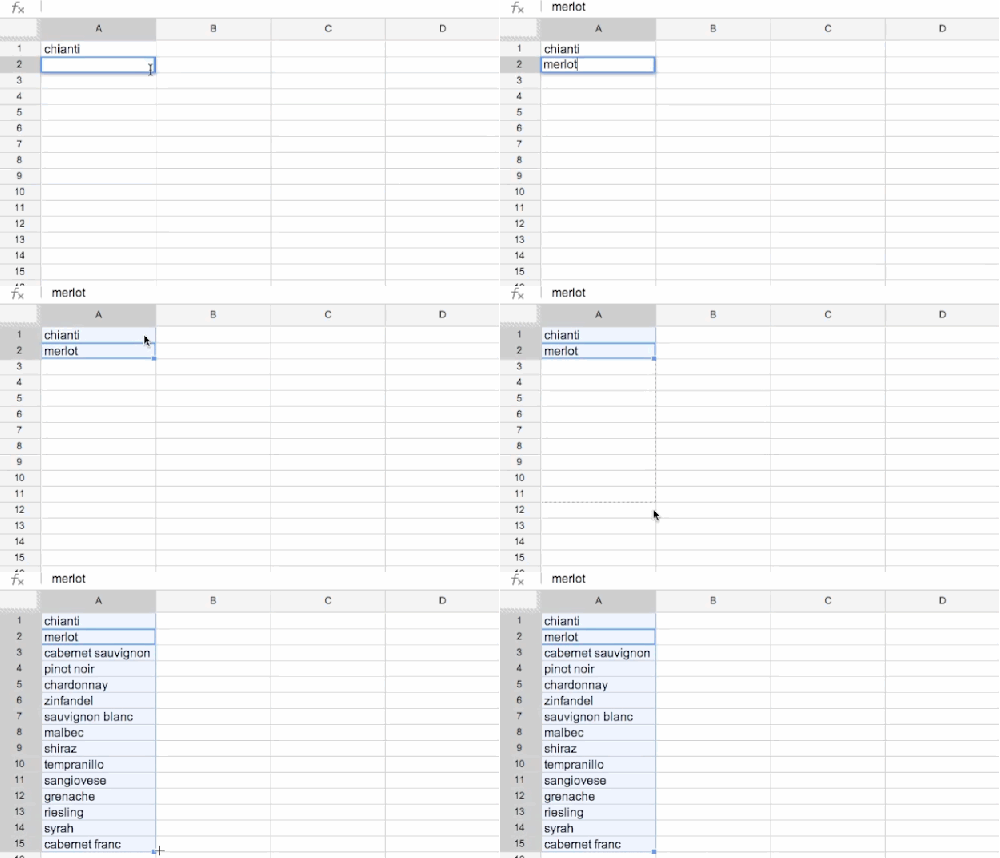
This would be cool if weren’t wrong. Chianti is a region in Italy that makes wine primarily from Sangiovese grapes. The rest are grape names. And then they threw in “Rose” a style of wine at the end. So close to being useful functionality. Is this why Americans are generally wine illiterate?
Hello all! The cold climate conference 2013 has just begun in downtown St. Paul. If you remember, exposure to the conference last year prompted me to take a another look at Minnesota wine and give it a second chance. This year I am rushing back from Georgia so I can work the event! Pre-conference activities are going on now and the main event begins tomorrow.
Despite the blustery snow of the Tuesday before the extended New Year’s holiday weekend, people still steadily streamed in to the Four Daughter’s Winery in Spring Valley, MN. A mother and her son, diverted from reaching Rochester to do their holiday shopping appeared to be successfully accomplishing their mission between the wine-related trinkets in the gift shop and the quickly disappearing bottles of wine lining the western wall. An elderly couple seemed slightly overwhelmed but curious about the menu items from the chef and a delivery driver deliberated whether to hold tight or press on as he acquired a bottle of wine for his wife. Yet, it was noticeable each time the staff patiently went through the wine offerings; no one was there specifically for the wine. Perhaps that crowd would roll in after noon.
The wine from Four Daughters, however, is what has recently been making a name for itself. At the International Cold Climate Wine Competition this past August, five of the winery’s seven entries received a medal. Their La Crescent took home the top honor of best wine at the competition. Not bad for an operation that recently celebrated their first anniversary. Much of this success is owed to their winemaker, Justin Osborne, whose winemaking history spans only as long as the winery’s. Justin, a Twin Cities native, was asked by his wife, Kristin’s family to be the wine maker of their future dream and fortunately for the Minnesota wine community, he accepted.
The question is: How did someone with little experience end up besting some with 10+ years of hard work and dedication? “I’m not the smartest winemaker in the world,” Justin modestly declares as he struggles to illuminate his process. “You do these four things well, and stay within the lines…you’ll have a good end product.” His goal is not to reinvent the wine making world, but to entrust solid wine making practices that have been proven to work. Yet, instead of taking large leaps and just hoping things work out, he takes small, measured steps at each point along the way. The content sigh of someone fully dedicated to their craft comes out as he points back to a little room off of the production that he has no doubt spent countless hours in. “I do a lot of testing.” The lab room at Four Daughters may be his second home or first depending on whom you ask.
So what are those four things needed to make good wine?
Grow good grapes
Get good juice out of those grapes
Have a healthy fermentation
Have a deft hand when refining (finishing the wine)
Simple, right? OK, there may be a few other factors going into the success. Being able to start off with some good equipment certainly helped. Additionally, Justin’s wife, Kristen is part of how the winery got their namesake. She’s one of the eponymous four daughters and her family’s agricultural background has certainly served them well in pursuing their dream to have a winery and vineyard not to mention the aid of Kristen’s marketing skills. The family and their expert staff didn’t walk into this venture unprepared. It also helps that the vast majority of the grapes they are purchasing are grown within 50 miles of their location. Their location also just happens to be within the largest wine region in the world: The Upper Mississippi Valley American Viticultural Area (AVA). See Justin’s number 1 rule.
Those visiting the winery may spot a life-sized cardboard cutout of Marilyn Monroe in a glimmering pink ball gown leaning on a wall of oak barrels. Is it inspiration for his Frontenac Rose? He shakes his head and begins, “My mother-in-law collects them…”. And really, that’s the only explanation a married man needs to give sometimes. He then relates the story of how the local police department, responding to a security alarm breach on the premises almost shot the cardboard version of John Wayne hanging out near the bathrooms. Clearly, it’s not just the customers who are pleasantly surprised by what they find what the find at this winery.
For the full audio interview check out the podcast below. Justin spills all of his secrets…well, almost. Regardless, if you make wine in the Midwest or just like drinking it you’ll enjoy the whole thing.
Brined cornish game hens, rubbed with clove and paprika and put on the grill. Risotto made from arborio, onions, broth, white wine, golden beets, and spiced with thyme, paprika, and clove. Ligonberries deglazed in white wine, spiced with clove, cinnamon, and thyme; spiked with some honey. Also with green beans sauteed in some olive oil.
Wine: Camino de Navaherreros 2010
Notes: I take delight in exploring the extreme perimeters of what my 4-year-old nephew will even consider eating. Apparently this risotto “Tastes like potatoes,” so I’ll go ahead and consider this to be a win for me on this one given my high number of failures in this game.
Anyway…
Lately I’ve been devouring François Chartier’s Taste Buds and Molecules which highlights his research in matching the volatile compounds (aromas/tastes) of wines to those found in food. While limited to flavor matching, it’s an interesting approach because wine science is just getting to the point where enough information has been cataloged to start doing this. I’ll probably post on topics around this at a later point, but for this experience, just know that the components of clove are chemically the same as those found in a number of red wines and grilled meats always have an affinity for wines put into some oak.
The results were of course spectacular. The theme of clove in varying potency levels in each of the parts of the meal were all brought out by the wine and vice-versa. The red fruit in the wine also made good friends with the ligonberries. Retronasally-speaking (breathing out through your nose after you swallow) all this flavor matching creates this heightened immersion into the food and wine which if done in overabundance could be overwhelming.
By the way, yes that is a guy riding a bear on the label which I think is now one of my favorite wine labels. “Herreros” translated means blacksmiths I believe or a skilled tradesmen, but I have no idea what the “Nava” part would be. So it’s the Path of the something-something blacksmiths that carry spears and ride on bears. I definitely want to take that journey.








 Aaron Berdofe's Wine and Food Experience