Feeds:
Posts
Comments

Archive for the ‘Fun Facts’ Category

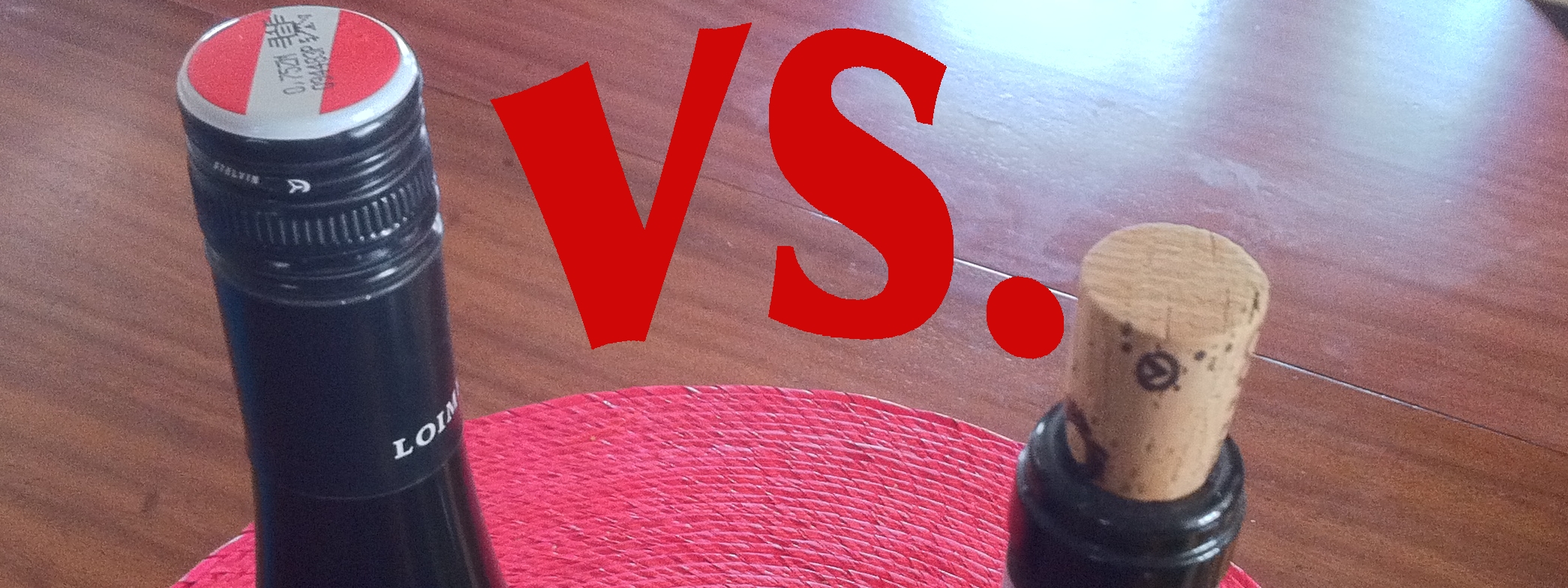
This may be one of my shortest posts, ever.  The evidence is in.  Which makes a better wine bottle closure: the screw cap or the cork?  According to Ron Jackson and his remarkable Wine Science text book, it really doesn’t matter.  Cork is used primarily because of tradition, not because it makes the wine age better or any other hullabaloo.  This has been verified by countless other people who actually spend time scientifically measuring this sort of thing.

Got it?

IT’S SCIENCE!!!!!!!

Read Full Post »

val·ue [val-yoo]

  1. a fair return or equivalent in goods, services, or money for something exchanged
  2. relative worth, utility, or importance <a good value at the price> <the value of base stealing in baseball> <had nothing of value to say>

 via Merriam-Webster

I tend do get a bit miffed when people use words incorrectly.  Not those times when it is accidentally used in passing.  That is instantly forgivable.  What isn’t is when a word is incorrectly used over and over again without the slightest notation of error.  Marketing and Advertising people tend to do it all the time, which is annoying, but can generally be ignored.  Business people do it with confidence (mostly in airports) in order to place a hot buzzword into a conversation regardless of what the conversation is about.  Industries as a whole have tended to abuse one word in particular and since this blog is about wine, I’ll focus on that industry.  That word is value.

If you ever see value wine listed on an advertisement you should translate that to what they really mean: cheap wine.  Generally, this refers to wines that sell below $10/bottle.  I suppose this came about when the industry was trying to figure out a way to make cheap wines look good to the consumer.  Undoubtedly, someone got a standing ovation at this meeting when they suggested they just switch the name to value wine.  Unfortunately, they forgot to understand semantics.

Here’s the deal: if you change the name of something that people already have a meaning for, the meaning still stays.  Have you ever seen an advertisement for so-called Luxury Apartments?  Most people mentally translate this to an apartment that’s overpriced.  Luxury means extravagant or abundant, yet if you ask someone what meaning that word has, they’ll most likely associate it with expensive.  So perhaps we should start calling all >$50 wines luxurious.

Value means that the price and the quality and your enjoyment of the wine matches the price you pay for it.  Related in semi-mathematical terms:

price = enjoyment x quality

If we want good value:

price < enjoyment x quality

And bad value:

price > enjoyment x quality

Using the real definition of value wine, does the industry’s claim make sense?  Sometimes.  When you’re dealing with lower end wines, you take a greater risk in terms of quality.  Most cheaper wines tend to be mass-produced and sourced from various locations throughout a country.  They focus on consistency in aroma and taste, not quality.  This is like comparing Ikea furniture to something that’s hand-made by a skilled carpenter.  Sometimes, you find that $6 wine where you get exactly what you’re paying for.  That’s a value.  Most of the time you just wish they’d still knock off a couple of bucks from the price because you have little to no enjoyment.

The term, value can therefore be applied to wines at any price, not just the cheap ones.  However, a true value wine is one where the price matches the quality and your enjoyment.  If you find a wine for $10, that you’d be willing to pay $15 for; that’s a good value.  If Two-Buck Chuck suddenly becomes Three-Buck Chuck, then that’s a bad value because it’s really only worth $2 .  Come to think of it, I actually value it somewhere just south of $1, which brings me to my last point:

Value is in the eye of the beholder. 

There are two fixed values in this equation.  The price, which is set by the winemaker/wholesaler/retailer and the quality which all falls on the winemaker.  The price, you can see.  The quality, you can infer by reading a good handful of expert reviews, your previous conclusion of the wine if you’ve had it before or if the wine shop is kind enough to put a solid blurb about it right there.  And then there is your future enjoyment of the wine.  Only you can decide this.  This will depend on what kinds of wines you like, what food you’re having with the wine with and how much you really care about quality.

All I ask is that you don’t let some marketing trick rope you in to only buying cheap wine.  There is absolutely nothing wrong with buying a cheaper wine if it holds value for you.  The same goes for buying an expensive bottle of wine.  Here’s a trick: Buy a bottle of Three-Buck Chuck Merlot (or another equivalently priced) and then buy a $15 bottle of Merlot from Paarl Hills, South Africa, or Walla Walla, Washington or Napa, California.  First determine if each bottle is worth the price you paid for it and then do a comparison.  Does the cheaper bottle hold a higher or lower value in your mind having had the more expensive bottle and then what do you feel about the reverse?  If you feel comfortable doing so, add in wines of the same varietal at higher and higher prices.  That will be  your basis for finding your own value wines.


Read Full Post »
I recently came across three different wine related items that I wanted to post on. Fortunately, I was able to meld these into a single, succinct trifecta post for your reading pleasure.  Each of these  deal with a topic I tend to talk a lot about at my Wine and Food Experience events: Buying wine.  Why is buying wine so difficult?  For you, that is, since you’re reading this.  Not wine nerds.  We find it pretty easy.

Freakanomics Radio:
Take a listen to the podcast.  It’s only about 5min. long.  In it, they talk about the economics of wine, because it is and industry after all, just like everything else.  The question they ask is how do we as consumers know what wine to buy.  We buy wine to enjoy it. So how can we make sure we’ll enjoy the bottle we buy? They reference an article by the Journal of Wine Economics  that states the people enjoyed expensive wines slightly less than they enjoyed cheaper wines.  The reasoning behind this (mine, not theirs) is simple. Buying wine, like buying anything else is a value proposition.  As long as we think we’re getting a deal, we’re more likely to enjoy something.  If we just bought a Picasso to show off to our friends, the experience will be…well, rather fleeting.  Because the general public in America knows next to nothing about wine we look to the experts to tell us what to get.  In the podcast they mention the 100 point rating systems that are common these days, but what they neglect to mention is that these rating systems are rating the wine quality not whether you’ll enjoy it or not.  This is much like a movie critic rates a movie.  Critics are wonderful for these purposes of judging quality of something because there are some hard and fast values that they are judging.  Much like a movie of a certain genre needs to contain certain elements (quantitative) and those elements can be graded (qualitative) wines are critiqued in the same way.  For example, all Cabernet Sauvignons will have similar aromas.  There is a range of what a Cab Sauv can smell like.  It smells like Cab Sauv or it doesn’t (quantitative).  Now how prominent that aroma is and the blend of the unique aromas within the range can all vary on a scale (qualitative).  All these ratings tell you is how good of a spot was picked to grow the grapes and the level of craftsmanship of the wine.  It won’t tell you whether you like it or not. Unfortunately, the podcast ends with no conclusion, no help and little information about how to actually buy wine. They even insinuate that only wine “snobs” buy more expensive wines and everyone else should buy cheap wines.  I always get a little worked up when people say things like this because it is simply untrue.  True wine nerds (or geeks) buy wines at a wide range of prices, because we appreciate the experience we have with each of them.  We also know that sometimes the best wine to pair with a meal, given our mood, is a cheap, simple wine.  Therefore, you can easily spot a true wine snob who doesn’t actually know much about wine if they flatly state that they won’t ever buy “cheap” wines.  The price you pay generally has to do with either the legally designated ranking of quality within the country of origin or because the wine is a premium brand.  Let’s face it, with everything else you buy sometimes you get whatever is on sale and other times you like to treat yourself. Wine should be no different.

Consumer Reports:
The second item I came across was while I was pursuing through the latest edition of Consumer Reports.  Apparently, they are rating wine now.  They are also doing it very poorly.  I have no idea how long they have been doing this, but they should either stop or rethink how they are doing it. Electronics, for example are rated on a number of factors like battery life, features, etc.  They’ve rated wine on…well, seemingly nothing except price.  Wine prices range between $3 to $1,000+ a bottle with most wines consumed in the US being in the $10-$30 range.  The wines listed in Consumer Reports ranged between $7 and $22, but what were they rating them on? If they truly wanted to do it right, they would rate wines by how good of a bargain they are. Let’s say there is a wine that sells for $14, but its quality is at a level that it could sell for $20; that’s a good deal! They could even use existing rating systems.  Let’s say a wine is rated by the Robert Parker system at 89 out of 100 points and it’s priced at $12.99.  Or maybe a delicious wine that has been aged for 10 years in oak, crafted from the oldest vine in a highly regarded vineyard going for $50 when it could easily be sold for $75.  Consumer reports could say “We recommend!” but alas, they have taught the consumer nothing about wine.  Epic fail, CR. Epic fail.

Wine Spectator:
The last item I came across was an article from Wine Spectator detailing the current conversation our American wine industry is having about naming conventions.  Herein lies our answer!  Let’s face it, reading through wine labels is confusing.  Each country subscribes to different rules as to what can be put on the label.  Some countries are very stringent (France, Germany) and some are quite lenient (USA).  This means that when you see the word ‘Reserve’ on a bottle of French wine it means that it’s been aged in oak for at least three years.  If you see that on a bottle of American wine, it has most likely been aged in oak for a few years, but that doesn’t have to be the case by law.  So to make it a whole lot easier on the American public, we could define what terms like ‘reserve’ or ‘estate-bottled’ actually mean so you know what to look for.

In the meantime, always remember that location is important.  So below is a quick list of some good regions to find certain varietals of wine.  If it’s a blend of different grapes (varietals) make sure the at least the primary grape is grown in a region that fits it.  After you find the region you are looking for, then you can determine how much you want to pay.  Always know that the more specific they are about the location, the more unique and fun it will be.  Keep in mind that the list below of regions or collections of regions is not exhaustive by any means, but the chances of you getting a bad wine while using this list are minimal.  There are many great wines in varietal or blend form from numerous other places in the world.  This is my “play it safe” list and I’ve limited it to just the Noble varietals.  It should also be noted that you’ll rarely find a <$10 bottle of wine from these specific regions (however, one of my favorites from Paarl Hills, South Africa frequently goes on sale for $6.99 a bottle!). Legally speaking, their governments have established standards that they must meet so they can justify that their wines are of a certain quality.  Want to know what the difference is between a $3 bottle of Merlot from California (not specified where in the state) is compared to a $30 bottle from the Napa?  You’ll have to try it.

Chardonnay:

  • Burgundy (France)
  • Napa or Sonoma (USA)
  • Southeastern Australia (Most regions)
  • Piedmont (Italy)

Sauvignon Blanc:

  • Loire Valley (France)
  • Bordeaux (France)
  • Marlborough (New Zealand)
  • Casablanca (Chile)
  • Sonoma (USA)

Riesling:

  • Mosel or Rheingau (Germany)
  • Alsace (France)

Pinot Noir:

  • Willamette Valley (USA)
  • Russian River Valley (USA)
  • Burgundy (France)
  • Southern New Zealand (Most regions)

Merlot:

  • Bordeaux (France)
  • Napa Valley (USA)
  • Walla Walla or Columbia Valley (USA)
  • Tuscany (Italy)

Cabernet Sauvignon:

  • Bordeaux (France)
  • Napa Valley (USA)
  • Coonawarra (Australia)
  • Tuscany (Italy)
  • Colchagua (Chile)
UPDATE:  Consumer Reports returned a message I sent them with some helpful considerations:

Dear Mr. Aaron Berdofe:

Thanks for taking the time to contact Consumer Reports®.  It is always a
pleasure to hear from our readers!

We appreciate your taking the time to write to us regarding our report on
wine.  Your correspondence has provided us with invaluable feedback on how
we’re doing.  Please be assured that our readers’ comments and thoughts
help shape the work we do.  I will, of course, forward your correspondence
to the appropriate departments for their review and consideration for our
 future reports.

Thanks again for taking the time to write.  Your interest in our work is
 greatly appreciated.

Sincerely,
[Name Removed]
Customer Relations Representative

Autogenerated epic fail.


Read Full Post »

Wine Legs (Tears)

Finally did some research into the “legs” or “tears” that appear on the insides of your glass of wine.  I had been educated enough to know that these had no marking on the quality of the wine and had something to do with the body of the wine, but not much beyond that.  So what are they all about? 

Evaporation

The alcohol in wine evaporates at a faster rate than the water.  It also has a lower surface tension.  So I don’t get too Geeky, the simple explanation is that beads are building up on the sides of the glass as evaporation occurs and then they fall when gravity takes over to cause the “leg” or “tear” to fall down the glass.  I find they are best looked at when there’s a flickering candle on the other side of the glass. 

In terms of quality, the percentage of alcohol in the wine is noted (i.e. 13.5%), but more importantly it’s balance to the remaining factors of the wine (acidity, tannin, etc.).  However, because the “legs” are created due to the processes of evaporation and gravity there is no way to relate the visual information with the gustatory or olfactory information you are about to receive. 

Read Full Post »

« Newer Posts