Feeds:
Posts
Comments

Posts Tagged ‘wine’

Being from Minneapolis, I have to be somewhat of a Hipster.  We are the Hipster capitol of whatever, as you know.  I’m not the glasses, flannel, and skinny jeans type; no (that’s so passé), but it is certainly not beneath me to state that something that has now become popular is suddenly uncool.  That something is the wine and cheese pairing party trend.  The mid-2000s called; they want their snobby party idea back.

Like most things I oppose, this one is mostly on principal.  I won’t belittle it because it gathers people together to quaff large quantities of wine while enjoying cheese on the side and a feeling of “fanciness” in the air.  No,  I fully support people who enjoy that sort of thing taking part in that.  It is the fact that the event is a complete sham and people are only maintaining the illusion that they are learning something about wine that I just won’t stand for.  And since I won’t call it out when some guy is talking about how amazing his wine and cheese parties are at a wedding reception and it’s “Just something [he] likes to do”, which apparently makes him a “Wine Guy”; I will do it here.   I’m so passive-aggressive.

So let me lay it out for you: why you should step it up a notch at your next wine-inspired event.  Don’t worry, I’m not going to crack down on the Kraft cheese.  That isn’t the issue.  I’m not even going to crack down on the casual appearance of Two Buck Chuck: still not the problem.  The problem is food science.

Cheese is composed of fat, protein. and salt.  That’s all of it.  The balance of which will cause you to define it as a creamy cheese (i.e. Brie), a salty one (i.e. Aged Cheddar) or something in between (i.e. Gouda).  Plastic-y is something else entirely.  Hopefully, you read the results of my rebelliousness previously and will at least pick up that salt has a certain affect on red wine.  Fats and proteins have long been paired with red wines because they bind with the tannins, thus reducing the cotton-mouth feeling you get from them.  Salt, as previously reported, has a similar effect, and also reduces bitterness.  If you add a couple grains of kosher salt to your coffee, you’ll get a similar smoothing as adding cream.  In fact, milk is still an acceptable additive in numerous parts of the world to ease the bitterness and astringency on overly tannic red wines.

Then there’s acid.  Acid in wine can help lighten up a heavy dish by “cutting through” some of the fat.  A dash of vinegar or citrus in a heavy cream sauce or soup can turn a dish from bland and heavy to focused and structured.  Voilá.  Thus, higher acid in wine cuts through heavy and creamy cheeses.

So here are the two experiences you’ll ever notice at a wine and cheese party. First, when you have a creamy or salty cheese with a red wine, you are masking the tannins or “softening” them in wine lingo and left with the fruit of the wine.  This generally encourages those who aren’t too fond of tannins to drink more red wine.  Then, if you pair an acidic wine with a creamy cheese, you’ll be ok with eating more of that cheese.  At the end of the night, you’re primary experience will be, “Wow, I ate a lot of cheese and drank a lot of wine.”  You will have spent most the evening masking certain items of either cheese or wine.  This is like erasing the horrible lead guitarist in the band and not replacing them with anyone better.

Wine and food pairing, much like a good band is about balance.  Everything has to play a part to create a more complex and enduring experience.  As someone who plays music solo a lot, I can tell you that I crave, crave, crave a full band sometimes to make it more interesting for the listener.  Do you want to listen to a drum solo the rest of your life? I didn’t think so.

When I’m doing a wine and food pairing event, I admit I’ll occasionally have a cheese and chocolate course at the end with a tannic red.  But it’s to show the specific effect the elements of cheese have on tannins in red wine. That’s a drum solo within a song.  Rock on!

Therefore, if you truly want to make the night an interesting experience over and over again, you have to change the mix of interactions between the wine and the food.  There are five different basic tastes you can play around with.  Have something sweet, salty, sour, bitter, and savory (umami) and then see what happens with each of those and the chosen wines.  You will learn something, I guarantee it.  From then on, you can taste a food or wine and ask yourself what you think is missing or what more you are craving to make that sensation balanced.

This self-impression of balance is what is being referred to when someone says,”This pairing did/did not work for me.”  But only by getting beyond wine and cheese events will you be able to answer the most important part to that, which is why.  There’s certainly a time for having a little wine and cheese as a snack, because sometimes simplicity and comfort are what we are craving, but that one note solo is not going to make for an entertaining evening again and again.

As a side note, if you really want to seem cool at these parties, use my music metaphor and tell people you need a little more of the bass line on a certain pairing trial and they’ll be astounded.

Read Full Post »

20120908-081954.jpg

Some friends are evil. They’ll pull at your heart strings, luring you into their cabin of evilness with ideas like: “Let’s go up north for the weekend (It’s something Minnesotans do constantly) and you pick out all the wine!”. This is both a brilliant idea, because you are guaranteed to get some really good wine, but a dangerous idea because you will also get a lot of wine and you will really feel obligated to drink it all. Perhaps this will be after a stop at a bar where one of you knows the owner and who simply will not let you leave without too many drinks on the house. Things happen in the Northland. It is the Vegas of the Midwest after all without all the glitz and well, the Las Vegasy stuff or the heat. Therefore, as my own version of a PSA, in order to save people from some tragic endings in the future, I have compiled a list of revelations that you should take note of.

Your Headache Is From Too Much Alcohol. Nothing Else.
I can’t tell you how many people have come up to me after a class and ask me how to prevent headaches from drinking wine. “I only had two glasses. I swear! It’s only after drinking wine that I get them.” Yeah, but that bottle of whiskey you had before the wine counts too, so don’t blame the wine. Here’s the only solution: Drink equal amounts of water and don’t drink too much. That’s it. It’s not the kind of wine. It’s not the sulfites in the wine. There are more sulfites in a small box of raisins than in your glass of wine so if you don’t have a reaction after consuming raisins, you aren’t allergic to sulfites. Read The Science of Wine, or Wine Science (basically any book with “Wine” and “Science” in the title) before you feel like debating me. If you currently have a headache and are reading this though, you probably don’t believe any of that so go ahead and blame whatever you feel like. Blame me if you’d like. I am the harbinger god of headaches. Happy?

If The Reverse-Thrusters Kick In, You Will Never Drink That Wine Again.
I’ve made mistakes in my youth. I’m not ashamed to say it. One was having waaaaay to much of a low-end wine which we’ll call Tiny Emu that may or may not have resulted in a noise violation at an apartment complex. Now, after seeing Tiny Emu going the wrong way out of my mouth, I will never look at Tiny Emu again. In this case, my wine acumen has developed to the point where Tiny Emu isn’t even an option, but many of you buy the same cheap wines over and over again. So there’s my warning. Wine puke.

20120908-083939.jpg

Bacon Sandwiches Are Your Friends The Next Morning
The British are known for a few things including habits of imperialism, dry senses of humor, and being hungover constantly. Therefore, they put some scientists on the important question of what cures a hangover. The answer they found was bacon sandwiches. Fortunately, this coincides with what a lot of young gentlemen Brits have in their ice boxes (they still call them that, right?). The carbohydrates are there to kick-start the metabolism to help you process everything faster and the protein breaks down into make-you-feel-better amino acids. It’s really best not to question theses things. Especially delicious things.

20120908-080600.jpg

Playing Drinking Games With Wine Does Not Make It Classy
First off, always sip and swish your wine no matter what. Chew your drink, drink your food as the old saying goes. This should remain true if a deck of playing cards come out and you’ve found yourself in a death-match of wits where wine is your poison. 20120908-080708.jpg
Look, I’m all for classing things up. My wine and food pairing experience is a classy alternative to the typical tawdry bachelorette party for example (and I’ve had numerous highly satisfied customers!), but replacing inferior beverages with wine does not make one classy. A wine-o perhaps, but I’m classy because of my other attributes and my wine drinking factor just happens to look good next to them. While sipping and swishing is certainly a better alternative to chugging, let’s be honest. It’s a drinking game and will most likely end in tears.
20120908-080941.jpg

Drunk Is Drunk Is Drunk
You may be drunk on wine, but don’t tell me you are “Wine Drunk.” You make the same faces when you’re Beer Drunk or Gin Drunk or Pappy’s Moonshine Drunk. Yes, we metabolize different drinks in different fashions, but don’t go around saying one makes you a happy drunk and another makes you cower in a corner, sobbing for hours. But consult Yahoo! Answers if you want. I personally find the advice of a woman who goes by the nom de plume of “slinkies” the best:

20120908-083409.jpg
Brilliant, slinkies. You are the source of all knowledge.

Read Full Post »

For all of those in the Twin Cities this Sunday stop on out at The Homegrown Experience on Nicollet Island. Lots of local vendors for food, beer, and yes, wine! I’ll be giving a presentation at 1pm on the importance of locality in wine and an overview of Minnesota wine. Hope to see you there.

http://www.thehomegrownexperience.com

Read Full Post »

I know, I know, it’s taken me forever to get this up!  Hopefully, this conclusion to my exploration of the sushi and wine experience makes up for trying your patience.  I promised charts.  I promised science.  I promised that you’d be able to comfortably pick out what wine you want for the experience you want when having sushi.  Ladies and Gentlemen, I deliver all of those things in this riveting end point to your wine and sushi voyage.  For the very impatient (aka lazy bums, slackers, non-geeks), please scroll to the chart at the bottom to get the answers without having to learn.

Where We Left Off…

In Part 1, we did a review of the existing “literature”.  By that, I mean we Googled the heck out of pairing wine with sushi and came up with a whole lot of nothing useable.  Preferences were listed aplenty, but no guides existed to help you in the sushi restaurant.

In Part 2, we reviewed the components of wine and sushi and laid out some plausible theories as to what kinds of interactions could go down when mixing and matching.  Here I brought in the insight of Tim Hanni, MW to get his take on what actually happens when wine and food are mixed in our noses, our mouths and our brains.  We also discussed some of the existing claims out there and Tim happily took down a lot of the nonsense that has been floating around.  At the conclusion I delivered 4 specific interactions that really affect the sushi and wine experience.  To repeat and save you the trouble of clicking the link and having to read:

  • When a flavor component of the food is similar to that in the wine, the experience of that flavor is enhanced.  This is called flavor matching.
  • The perception of alcohol will increase when paired with sweet, umami-tasting or spicy foods.
  • The perception of spiciness will decrease when paired to a wine with more acidity.
  • Tannins will noticeably diminish when they encounter salt (soy sauce), citric acid (lemon juice) or vinegar (pickled ginger).

 Some More Science

In doing some more research on flavor components, I came across a fascinating article in Nature entitled Flavor Network and the Principles of Food Pairing.  When you mix wine with food, it’s really an extension of the existing ingredients that are already in the dish. We have our preferences as to which herbs and spices work in which dishes, so we should have our preferences as to which wines work with which dishes too.  In the article they broke down all of the components of food down to the compound level.  You see, it’s the combination of certain compounds that we interpret as flavor and aroma.  Then they ran through various recipe sites on-line and compared which components always showed up together and which ones did not.  The most interesting outcome of this study was that they found in Western cooking, we generally like to put together ingredients that share compounds.  In Eastern cooking, we generally like to put together ingredients that do not share compounds.  Now think back to the first interaction I listed.  If two items match up on flavor/aroma compounds, then that flavor/aroma will be enhanced.  If two items don’t match up on the compounds, then nothing is really enhanced, but things are made a bit more complex.  Trouble wrapping your head around that one?  Thankfully, the authors of the paper came up with an excellent chart to show which ingredients share components (closer together) and which ones have differing components (farther away).  Definitely click on it to get the larger view.  

To associate this with our sushi and wine pairing, this means that if we have a wine that shares a lot of compounds with the components in the sushi, we are going to get an enhancement of that particular flavor or aroma.  The wines that do this are going to typically be whites since they carry a lot of the green, tropical fruit, floral, and minerally components.  If we have a wine that diverges from the compounds of the sushi components, we are going get a more complex sensation of taste.  This will happen with the vast majority of reds with their more earthy, red fruit, and black fruit components.  I generally like to think of this concept in terms of sound waves because they do the same thing.  A sound wave is enhanced if the same wave gets overlaid on to it and the sound wave is neutralized if the exact opposite wave is laid on top of it.  [As a side note, the latter method is essentially how noise cancellation works.] [As a side note to the side note, I think the idea of creating flavor or aroma component “chords” is something very real and needs to be explored]  Therefore, the first decision you have to make is whether you want an enhancement of certain components with your wine and sushi pairing or if you want to add complexity to your experience.  Posting the common aroma descriptors of each varietal would make this post a bit lengthy, so I’ve simplified the concept in the chart at the end.

The second decision you have to make is how much of a wasabi kick you are looking to get.  If you’re eating sushi the “proper” way, you should only have a tiny dab with your bite (if any at all), but some people have been known to take a chunk just to get that brain burn feeling.  Again, a reminder that the wasabi you are having is really horseradish, mustard and food coloring and not actual wasabi, but the effect is generally the same.  One way to control the amount of kick is to simply control the amount of wasabi you are ingesting at a time.  However, one can neutralize some of the effects of the spiciness by taking a swig of wine that has some noticeable acid in it.  This is nice for those who are not so daring to swallow a chunk of wasabi outright, but might enjoy the pepperiness that it brings.  The exact proportions will differ by person, but it’s certain that if you take a lot of wasabi in at once, no amount of acid will diffuse that shooting burn you’ll get through your brain.  It’s the in between area that there is room to play.  On the flip side of that, if you have a wine with more pronounced alcohol content, that kick may be heightened depending on your level of sensitivity.  The more tolerant taster who doesn’t noticed higher alcohol content in wines as much (as a burning sensation in the back of your throat near the nasal cavity) may be more tolerant of spicy foods to begin with.  The more sensitive taster should take note though.  For those who like to live on the edge, take something 100 proof alongside a big chunk of wasabi.  I’m sure it will be a trip you won’t forget.  If anyone wants to create a shot based on that, all I ask is that you send a small portion of the revenue from all of your “I survived….” merchandise my way.

Last, we consider the tannin factor.  That cotton feeling you get wrapping around your tongue generally with red wines.  This was a big point of contention on the internet as the red wine purists couldn’t understand why their tannins had disappeared and the rest of the people didn’t want them there in the first place.  But are we just restricted to white wines or red wines sans tannins when eating sushi? No! You can have the wine you want with the experience you want, but you may need to take steps to get it that way.  Let’s remember that the sensation of tannin decreases significantly when you add in citric acid, vinegar or salt.  We can get citric acid from a lemon slice, vinegar from pickled ginger and salt from soy sauce while we’re eating sushi.  Use these as your tools.  You want all the tannin goodness your favorite wine can provide?  Stay away from dunking your bite of sushi into soy sauce; forgo the slice of pickled ginger in between bites.  Your tannins will be there every step of the way.  What’s that? You inconsiderately ordered a bottle of tannic red wine without asking the people you are with what they want and they don’t want any tannin at all?  Well they’ll be resigned to getting a bit more soy sauce on each bite than they’re used to; having a slice of pickled ginger in between bites; or maybe just squeezing a bit of lemon over everything.  The moderates can find their ideal balance somewhere in between with a little trial and error using the tools available.

Now, I wouldn’t have gone through all this work without trying these theories out on unknowing participants.  That’s not my style.  An event was put together with 15 people to verify the effects of these interactions with 4 different wines and an assorted collection of sushi.  Was it scientific? Not remotely.  Did it successfully verify that people who just like wine and also like sushi can use this information to identify what wines they like best with sushi? Absolutely. We used all of the common ingredients found in sushi restaurants in Minneapolis and tasted four wines throughout the night: Grüner Veltliner, Viognier, Carmenere, Shiraz.  Keeping in mind that the impression my internet searching left me with was that people shied away from reds when eating sushi, it was a fun surprise to discover that with the tools I had given the group, the overall favorite pairing was the Shiraz.

The key, as with just about everything, is balance.  More importantly, it’s knowing what you are balancing.  Three questions need to be asked when you sit down to sushi and you’re deciding what wine you want.

  1. How much wasabi kick do I want?
  2. How much tannin do I want to be noticeable?
  3. Do I want flavor enhancement or flavor complexity?

Charts!

Add acid to manage excessive wasabi kick

Alcohol will increase the wasabi kick moderately

Finally, here is the chart that was given to the willing subjects.  The wines listed are all of those available at the various sushi restaurants in Minneapolis and St. Paul.  Notice how it guides you toward achieving balance through trade offs.  Happy pairing!

Read Full Post »

There’s a common adage that floats around when people discuss viticulture that the vines must be stressed during the season to produce wonderful grapes for the harvest.  Those of us that know little about horticulture, take a sip of wine so we don’t have to talk, nod politely and associate this with the romanticism or mysticism surrounding wine.  I’ve come to discover that most of the people who state this adage emphatically, have no idea what they are actually talking about.  When you press these people for more on the topic, they mumble things about poor soil quality, restricting water and maybe add the word terroir randomly before quickly changing the subject (worked for me!).  To relieve the suspense up front, it isn’t that this old saying is wrong, it is very right.  But I try not to go around saying things when I don’t know what they mean.

While the title of this post may seem a bit cheeky, I promise I’m not misleading you (too much anyway).  Without further delay to your knowledge gratification, let’s get down to the dirty business of stressing the vines.  I’ll try not to let too much hot vine on vine action get in the way of what I’m trying to say.

Bow Bow Chicka Wow Wow. Oh baby! Too late!

Plants generally reproduce in two ways: one is called vegetative reproduction which can be thought of as plant growth or self-replication and the other is good ol’ sexual reproduction.  Concerning our beloved grape vines, vegetative reproduction is when the vine puts the energy it is generating into growing the vine and its roots.  Sexual reproduction is where the vine puts the energy into making seeds so it can further its genetic line elsewhere.  Jamie Goode puts is wonderfully in his Science of Wine book:

Generally (and simplistically) speaking, if conditions are good and a plant is doing well, then, if it can, it opts for vegetative reproduction or just grows larger – after all, there’s clearly a good match between the plant genes and the environment and it wants to keep things that way.  On the other hand, if conditions are bad, plants will more often choose to reproduce sexually (the “I’m outta here” option), which requires fruit production.

Let’s talk about the Birds and the Bees, shall we?  A vine may reach a certain point in its life where it gets that “funny feeling”.  Of course, in this instance, the feeling is the realization that the vine’s current home, terroir if you will, just isn’t working out and it needs to sow its seeds elsewhere (literally speaking) to continue the genetic line.  Through the course of evolution, the vine has developed symbiotic relationships with certain insects (i.e. bees) as well as animals (mostly birds).  Never one to go it alone (seriously, they’re so dependent), when the vine decides it needs to reproduce, it grows flowers which signal the bees to do their thing on itself or with other vines.  Come to think of it though, domestic vines are mostly hermaphrodites so I guess there is really just a lot of “self-pollination” going on.

Don't come in! I'm...um...changing.

After the bees do their part and the grapes start to grow, the vine cues the birds.  [Birds enter, stage right and all aflutter]  The “cue” in this case is when the grapes turn from small and hard grapes, to fat and juicy ones.  In the viticulture world, they call this point veraison.  Now, grape growers wait a bit after this to pick the grapes because they develop a little more after this point, but this is the dinner bell for the birds to swoop down and eat the calorie-filled tasty treats while swallowing the seeds whole.   As one would assume, birds and farmers generally do not get a long very well.  I don’t need to describe the seed extraction process from the bird in detail, but the hope is that the bird does that elsewhere and in a lovely new home for a future vine.

Thank you, internet.

Which brings us back to stressing the vines.  For the best possible grapes, we need a good strong vine that puts a lot of energy into producing fruit.  If everything is dandy in the vine’s world, it won’t feel the need to spread its seeds which means little or no fruit.  On the other hand, if things are absolutely horrible, the vine won’t spend anytime doing personal development, it will just be in eject mode which means a weak vine.  Therefore, you have to give your vine everything it wants (adequate amounts of water and sunlight and maybe some supplemental minerals) to get it nice and strong and then “stress” it or deny it some of its needs just enough to get it to feel the need to produce fruit.

Various examples of a commonly used vine "stressing" apparatus.

How you do that is both an art and a science, depends a lot on the terroir (geography, climate, weather, etc.) and what grapes you are growing.  Because the weather changes every year, there is a level of unpredictability in what the vine will need each year to get to that balance of ideal vine and fruit growth.  A great season weather-wise will do most of the work, but this doesn’t always happen.  This is why there is much ado about vintages, but that is a subject for another post.

OK, so this post really should have been titled: “Stressing the Vines” Is All About Sex(ual Reproduction)!  But hopefully I threw in enough hot vine on vine action to keep you satisfied.  Whatever you do with this information, please, please, pleeeeaaase do not tell those vines that we are stealing their children and using them to make a heady beverage.  Let them think their seeds are settling in greener pastures and leading a better life than they ever could have had.  Perhaps, it is best to keep them in the dark about this one. For our sake’s anyway.  They may end up coming after ours.


Read Full Post »

Oxygen.  We keep it out as much as possible when making the wine and then we add as much as we can in when drinking it.  We swirl.  We decant.  We aerate.  Adding oxygen into the wine right before we drink it is such a thing that a good portion of the wine accessories business is devoted to it.  But why?  What does mere oxygen do that improves the experience?

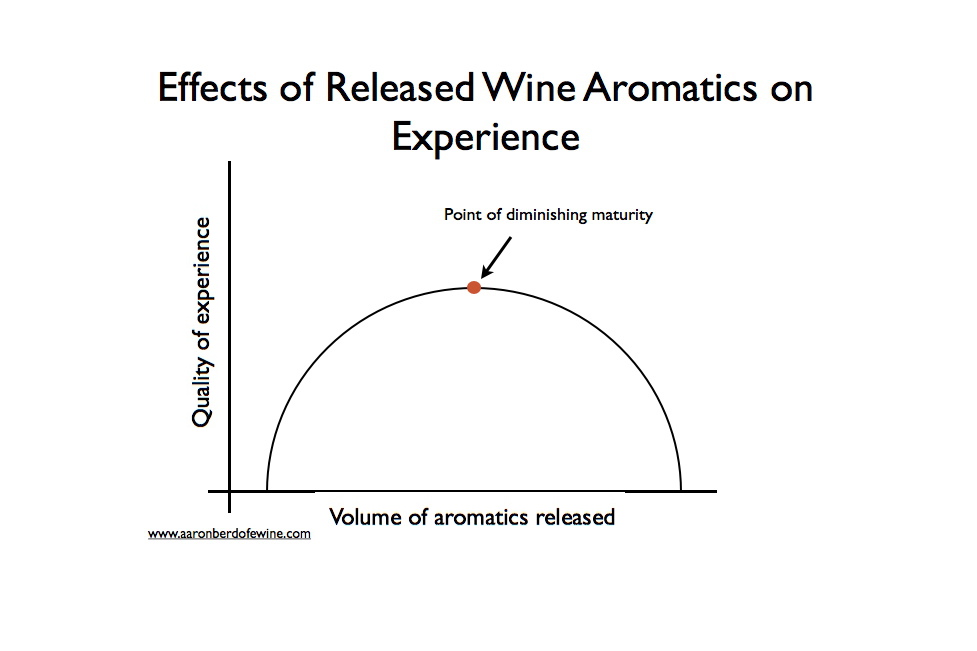
The theory (which has a bit of science backing it up) is that when oxygen hits the wine, the aromatics (esters, terpenols, etc.)  that have been tightly bottled up are encouraged to be released.  As more aromatics are released the wine should be more intense on the nose and then more balanced and apparent on the palate as well.  However, a wine has a finite amount of aromatics so there should also be a point of diminishing returns.  How far along the curve (the wine’s lifespan) the wine is generally referred to as the wine’s maturity, so I’ll call this the point of diminishing maturity.  Please feel free to use that term when referring to people as well.

winearomaticsexperiencechart-0012

There are a few other factors that go into why the quality of experience in wine starts to decline at a certain point, but here we are focusing on you enjoying your glass of wine at the table which is mostly concerned with the oxygen interaction (and serving temperature).  To test this theory, I decided to put together a little trial using a bottle of Philippe Leclerc’s 1996 Chambolle-Musigny Les Babillaires.  That’s a Pinot Noir from Burgundy for those who haven’t memorized every appellation in France.

The question: Does increasing the amount of oxygen in the wine right before you drink it intensify the aromatics on the nose and also have a positive effect on the intensity, balance and finish of the wine on the palate as well?  Given the existing, although limited studies on this already, one would hypothesize that the answer to this question is certainly yes.  I was also attempting to answer this question because I generally despise wine accessories.  For me, all I need is a double-hinged waiter’s corkscrew and a glass.  Also, I really like swirling the wine in the glass and I needed justification to continue doing it.  With this question I am assuming the wine is going to be served at the proper temperature.  The colder a wine is, the less oxygen can work its magic on it, which is generally why we serve white wines at a colder temperature and reds at a comparatively warmer temperature.

Mwhahahahaha!

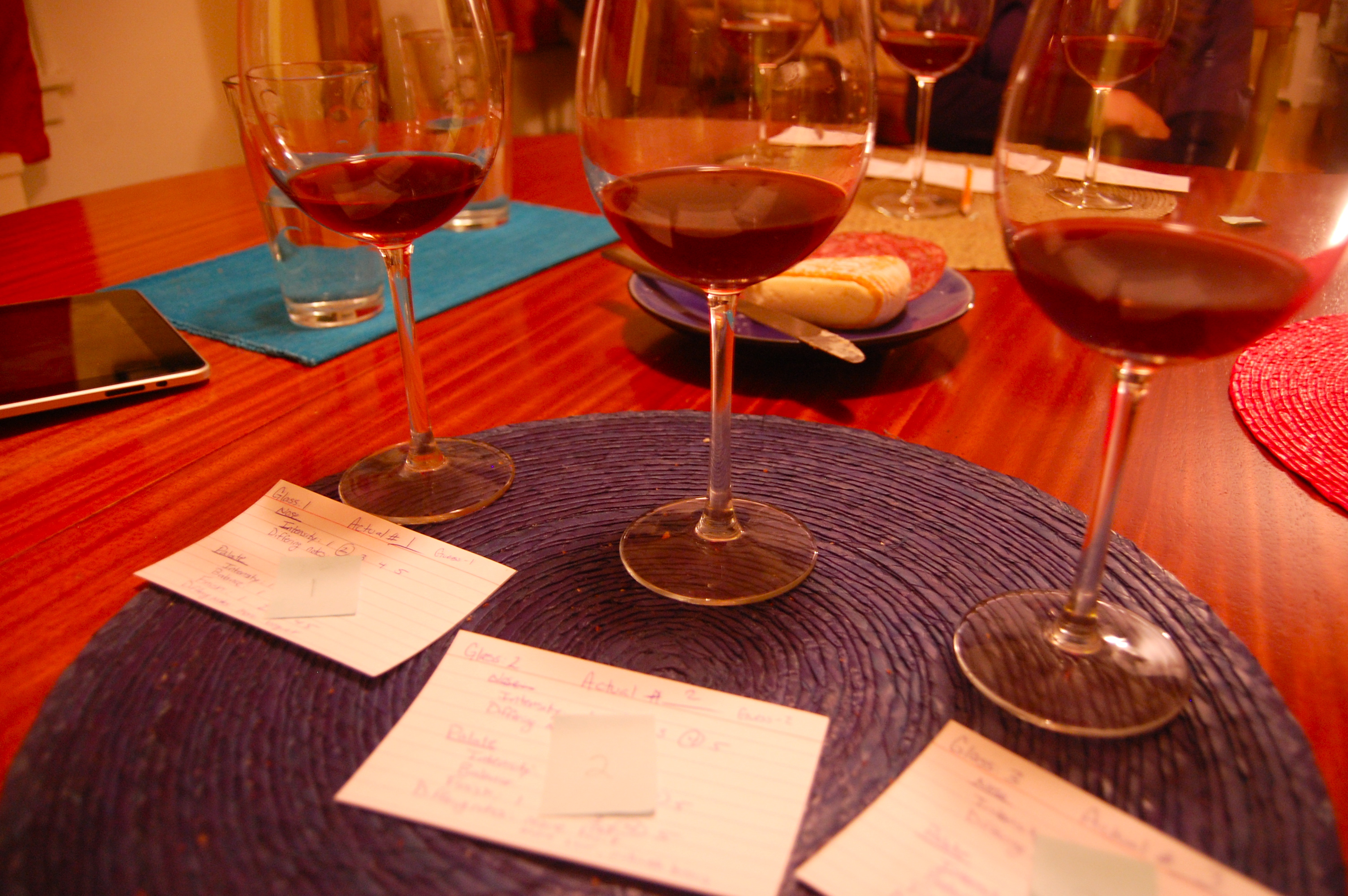
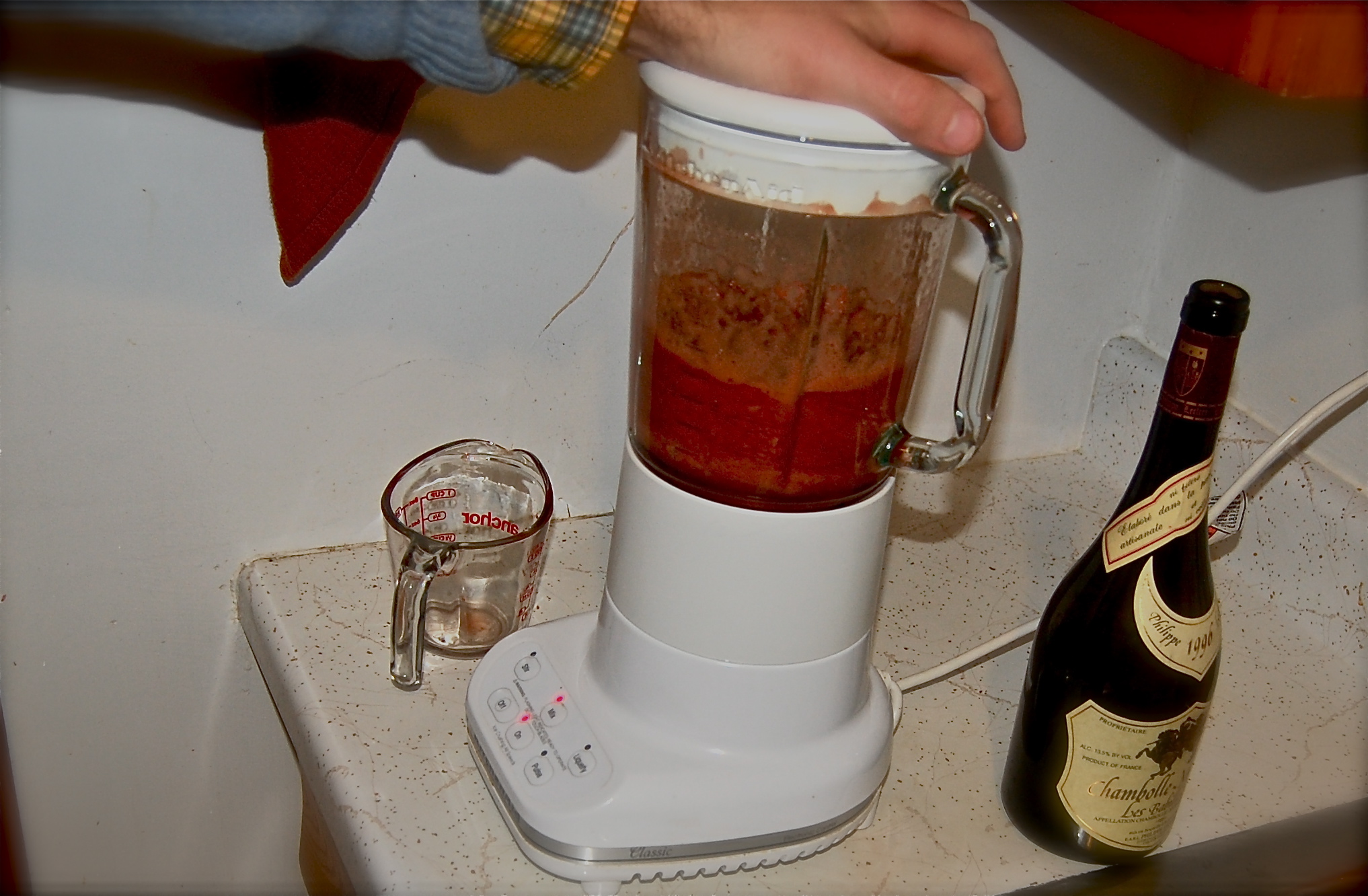
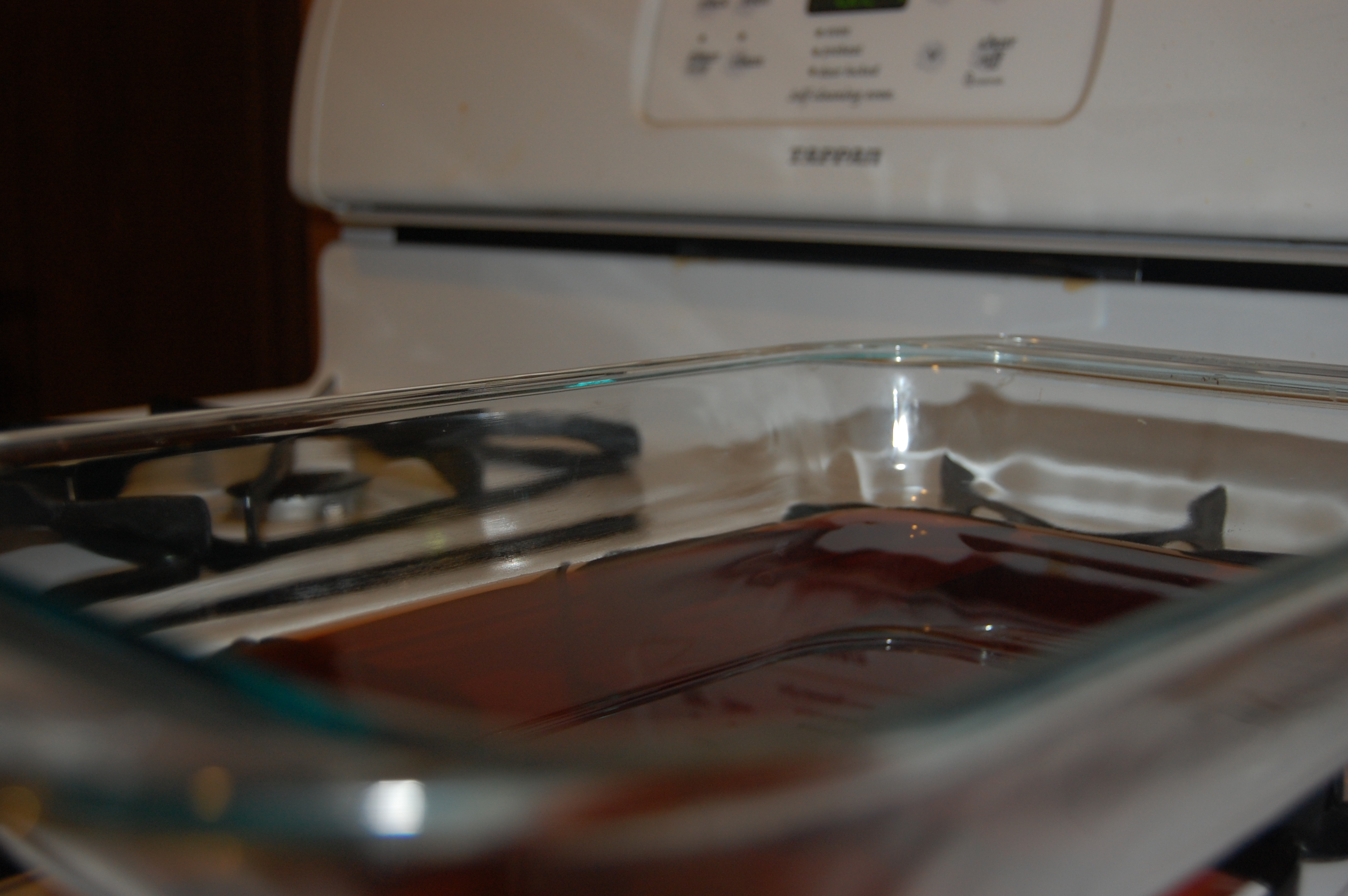
The methods:  Three different applications of oxygen to the wine were tested in this double-blind controlled study.  First, 250ml of the wine was poured into a measuring cup and then split between two wine glasses (the control of pouring directly from the bottle).  The second was 250ml of the wine poured into a measuring cup and then a 9″ x 11″ glass pan to expose as much of the surface of that wine to oxygen as possible. Third, 250ml of the wine was poured into the measuring cup and then a glass blender which was put on a low setting (such as “frappé”) for 30 seconds.

The pan

The second and third methods were then poured into respective glasses just as the first.  Each glass was labeled on the bottom (hidden) with the number of the method (1-3) for a total of 6 glasses, 2 for each method.  At this point I asked my paid assistant (paid in wine!) to leave the room and I rearranged the order of the glasses within each set.  After that, my assistant rearranged the glasses again while I stepped out so neither of us knew which order the wines were in, but we knew we each had one of each method.

Why the chosen methods?  Because I’m a huge nerd.  The first method acts as a control since it’s typically how people open and serve wine.  The added step of putting it into a glass measuring cup first was added to maintain consistency for the other methods.  Also, in the interest of consistency, if a glass was swirled, the other two glasses were swirled as well.  The second method is meant to mimic putting wine into a decanter.  I have two decanters, but by spreading the wine out on a flat surface as thinly as possible, the hypothesis that more oxygen on the wine increase aromatics is better tested.  The third method, the blender or Hyper-decanting as it is called, was popularized by Nathan Myhrvold the former Microsoft CTO that got bored one day and created a cookbook that focused on how to cook instead of what to cook (and it’s really cool).  The idea behind hyper-decanting is that it “chops” oxygen into the wine, moving oxygen through the wine instead of the normal lazy interaction oxygen has with the wine when it just sits there.  If you need a visualization, picture those movies that show an old school dance where the boys and girls sit on separate sides of the room and maybe one or two of them are dancing together.  That’s the normal wine and oxygen interaction.  Hyper-decanting is when the adult steps in a forces everyone to find a partner.  Also, the punch gets spiked.  Hijinks follow.

The rating:  This was a comparative analysis.  Therefore, each glass was analyzed briefly first and then a second analysis would be conducted and rated.  This ensured that if a glass was rated as having the highest level of intensity in the nose and the next glass was found to be more intense, chaos and anarchy would not ensue.  For the nose, Intensity was scored on a 1 – 5 scale with 5 being the most intense.  A Differing Notes commenting field was also included for more qualitative aspects.  For the palate, a 1-5 Intensity scale was also used along with a 1-3 Balance scale, a 1-5 Finish scale and a Differing Notes commented field as well.  In retrospect, the scales could have all been 1-3 since there were three glasses and this was comparative, but that didn’t affect the outcome and it did make the scorecards seem a lot more sciencey.

The results:  The assessments completed by my paid assistant and myself were nearly identical even though they were completed in silence.  The hypothesis that the more oxygen that gets added to the wine just before experiencing it was indeed correct, but with one twist.  The first method of direct pour produced a glass of wine where the experience was less intense and the characteristics of the wine tended to be more to the earthy spectrum while the fruits were more hidden.  The second method was more intense, but specifically with the fruit.  In this case, tart cherry came through and the tannins were more apparent.  The balance had gone a bit haywire.  The third method, which reigned supreme, boosted the intensity all around and the more earthy tones came back in to the picture to balance out the fruit.  The tannins then felt more appropriate and the finish appeared to linger just a bit longer which was most likely because of the improvement in balance and intensity.  As an added bonus, I guessed which glasses contained which methods correctly before the number labels were retrieved!

The conclusion: The wine that was tested was probably just past its prime (past the point of diminishing maturity).  Therefore, the results may change a little with the use of a young wine or an older wine in its prime, but I doubt the changes will be significant.  I can confidently state that forcing oxygen into the wine will noticeably improve the experience of a glass of wine.  However, it does appear that merely letting oxygen sit on top of the wine does not improve the experience and may even detract from it.  It may be related to headspace above the wine as Ron Jackson points out in his Wine Science textbook, pg. 503:

When the bottle is opened, aromatics in the headspace escape from the bottle.  The changed equilibrium between aromatics in the wine and the headspace induces further liberation of aromatics.  This phenomenon helps maintain the aroma in the glass during tasting, but may depauperate the fragrance of wine left in the bottle.  

If we arrange the methods in order of amount of headspace, it would be wine in the glass, wine in the blender and then wine in the pan.  It should be noted that a typical decanter does not have the same amount of headspace that wine in a pan does.  Perhaps, given the vast amount of headspace, the wine decanted into the pan went past its optimal point of maturity as was noted by the lack of bouquet or earthy tones to support the fruit tones.  Depauperate indeed.

Additional studies should be made (by me or at least invite me over if you’d like to do them) to compare all of those wine accessories and how well they actually affect the experience.  My guess is that you could get the better results from your blender than shelling out extra dough this holiday season for a fancy, single-purpose tool though.  Last, I do have to end this with addressing those who view wine as a fragile and ethereal object that should only be treated with kisses and caresses: Get over it.

Read Full Post »

In my Sushi and Wine Part 1 post, I did a survey of the existing help a person may find browsing the internet on pairing wine with sushi.  The results were not good.  It turned out that given the number of conflicting views that existed, people should just give up and drink sake (or a gin martini!) instead of attempting to drink wine with their sushi.  While disheartening for wine lovers who also eat sushi, I would not be deterred.  Sushi, after all is just food and there is a science behind how wine interacts with food.  Let’s break it down!

<Insert upbeat transition music>

Basic food components of (Americanized) sushi: raw fish (tuna, salmon, snapper, etc.), rice prepared with rice vinegar and sugar, soy sauce, pickled ginger and wasabi (although a lot of times it’s just a colored horseradish and mustard mixture).

Additional food components in rolls: carrots, cucumbers, mango, sprouts, mayonnaise (sometimes “spicy”), cream cheese, crab (fake or not), nori (the seaweed wrap) and tempura (batter of mostly wheat flour that things can be fried in).

This is by no means an exhaustive list, but it is pretty comprehensive if you consider the vast majority of sushi consumed here in America.  One thing to notice here is that even though sushi and wine pairing is kind of an unsettled thing, the taste components of sushi don’t differ from any other foods.  You still perceive the primary tastes* sweetness, saltiness, bitterness, sourness and umami from sushi, just as you would any other meal.  Theoretically then, sushi shouldn’t be treated any differently than if you were considering a wine for another type of meal.  So where is the disconnect?  Does the dunking of the sushi into a vat of soy sauce (umami and saltiness) really “kill” a wine.

In researching how sushi and wine can interact with each other, I decided I needed to know a little bit more about the science of taste.  The journey ended up leading me to the one and only, Tim Hanni, MW.  Tim is known, amongst other things, for two firsts: Being one of the first two resident Americans to receive a Master of Wine title and for being the first to introduce the flavor component, umami into the wine and food community lexicon.  The latter has given him the tongue-in-cheek (almost literally) title as The Swami of Umami.  Visit his website through the link for a whole host of interesting materials.

“There are actual differences in how people experience some sensations. It’s not that one person has a better or worse palate than another.”  Tim stated, referring to the idea in the wine world that one has to “mature” their palate to truly appreciate the best wine and food pairings.  In his teachings, we all fall somewhere on a scale of how sensitive a taster we are.  The highly sensitive tasters can notice interactions to a high degree while a more tolerant taster might not even notice it at all.  An example he gives is experiencing a wine with a high alcohol level.  A more sensitive taster will experience almost a burning sensation which can be heightened if paired with a sweet or umami-laden food.  The tolerant taster, on the other hand could find the sensation to be almost sweet instead of a burn and not mind the food/wine combination at all.

More specifically, about sushi, I asked him about the claim that soy sauce “kills” wine.  “I hate that. Most people don’t actually pay attention to what is happening in their mouth and the ones who should (writers, bloggers, “experts”) often pay the least attention – they write about wine and food interactions that they have never taken the time to isolate and experience. Do you have a bottle of red open yet today?”  I didn’t.  I’d just gotten done with a 3-hour bike ride and was still in full gear, sans helmet.  “Ok, well I have this bottle of red here that I’ve been working on today and…it’s ok, it’s not that good.”  Tim is very much a hands-on kind of educator. “And I have a little bit of this soy sauce…then the wine…and this wine actually tastes better with the soy sauce.”  So no, wine isn’t “killed” by soy sauce.  What does happen, is that the perception of tannin in the red wine noticeably diminishes due to the salt in the soy sauce.  Therefore, someone expecting the astringency (and also considering the presence of those tannins the mark of what the wine should taste like in the case of many wine professionals) might consider it a bad pairing while someone who doesn’t particularly enjoy that sort of cottony-feeling in their mouth might consider it a good pairing.  Tim, had just answered the question as to why there was no consensus in the on-line world as to what wines were good with sushi and what wines were not.  It’s all about perception.

<Insert dramatic transition music>

Therefore, pairing wine and sushi (or to any dish really) is not so much about finding the perfect wine that everyone agrees on, but discussing the sensations that are possible and letting someone figure out which ones they like. The experience of flavor matching, on the other hand; the concept of hooking up a similar aroma or flavor from a wine to one that is found in the food, will probably be consistent across the board, but one would need to decide if they want to up-play or down-play that flavor.

Now for the theoretical part.  Through my research so far, I’ve come up with 4 interactions that generally make up and affect the wine and sushi experience.  Just 4, you say? Yes! Just 4!  These 4 guidelines will assist people in choosing the wine and sushi pairings that work for them.  If you’d like, you can play around with these interactions as you eagerly await the exciting conclusion of my sushi and wine research.  Part 3 will involve experiments, charts, more science and as promised, a guide to show you what to order at your favorite sushi restaurant based on what kind of experience you want to have.

The 4:

  • When a flavor component of the food is similar to that in the wine, the experience of that flavor is enhanced.  This is called flavor matching.
  • The perception of alcohol will increase when paired with sweet, umami-tasting or spicy foods.
  • The perception of spiciness will decrease when paired to a wine with more acidity.
  • Tannins will noticeably diminish when they encounter salt (soy sauce), citric acid (lemon juice) or vinegar (pickled ginger).

*More and more research is showing that taste takes on a hierarchical form with the primary tastes on top and their variations underneath.  At least 5 different types of bitterness have already been sussed out and there is little doubt that more will be found including sub-types to those sub-types and perhaps more tastes than the 5 general tastes already labeled!

Read on to the exciting finale: Sushi and Wine Part 3!

Read Full Post »

-Taken at Las Niñas Vineyard and Winery, Apalta, Chile, December 2009

Today’s Dietitian, a well respected magazine for nutrition professionals has a nice article on wine and health in their August issue entitled: “To Good Wine…and Better Health – The Case for Moderate Wine Consumption”

There are some great quotes from yours truly peppered throughout so give it a read to learn about what we know about how wine affects our health. The general question asked for the article is if the health benefits of drinking wine are enough for people to start drinking it regularly (and moderately). Wine producers, distributors, magazines and others in the industry will emphatically tell you “yes” without hesitation. But what does the science actually say about this? My point of view is that if you do anything for the wrong reasons you’re generally not going to get the benefits you thought you would. There is plenty of correlation with moderate wine consumption and healthy longevity in certain cultures, which could lead to direct evidence on how wine gives us a health boost when dealt with responsibly. I really do think moderate wine consumption is part of a healthy lifestyle, but let me close with a question: If you asked a rural Italian why they drink the wine that their town produces do you think they’re going to say it’s because of the health benefits?

Read Full Post »


I was recently at a sushi restaurant in Chicago satisfying a seafood craving and I struck up a conversation with the owner who was tending the bar about her wine list.  It was a standard wine list, that is to say it had an equal number of reds and whites all reasonably priced and nothing too interesting.  As I sipped my dry, gin martini I inquired what wines were her big sellers.  She rattled off some of the whites which was no surprise, but then also listed some of the reds which given the reds that they were made me more disappointed than surprised.  Finally, after I reaffirmed my conclusion that people generally have no idea what wine to pair with sushi, she thew in her words of wisdom: “Drink Saké!”  Since this was followed by a free saké tasting, I wasn’t one to object.  But that conversation got the gears turning again about pairing wine with sushi.

Pairing wine and sushi can be a difficult thing.  Not because it is impossible, but because there is a lack of information.  When searching for a good wine pairing to go with just about any other type of meal, the internet is our friend.  What wine would go with this pasta dish I’m having? Google it and gather a consensus.  What meal would go with this wine I just picked up.  Google it and gather a consensus.  Yet, when it comes to pairing wine with raw fish, rice, soy sauce and wasabi, the internet, whom we thought our friend, leaves us hanging in our time of need.

Since there is a lack of information, I will be adding some data into the ether-sphere through this captivating mini-series.  This first part will summarize all of the existing knowledge on pairing wine and sushi that exists on the internet today.  The next part will get into how the food components should match or should not match the wine components and I’ll probably round the whole thing off with a good trial of pairings to verify what works and what does not.

To narrow my focus, which no one else has appeared to do, I’ll be sticking to the items and terminology that are common in a sushi restaurant found in the USA: Sashimi (Just the fish), Nigiri (Fish, rice, dab of wasabi) and those gigantic rolls that you might choke on when you put the whole thing in your mouth in one bite.  I’ll also include the condiments: wasabi, soy sauce and pickled ginger.  This is to say, I’ll be focusing on Americanized “sushi”, because let’s face it, that’s what most of us have access to and are likely to eat.

The Summary

If you were to Google “sushi wine pairings”, it might as well just return two words: Good luck. Of the little information that exists, it is mostly contradictory, based entirely on preference or not applicable to the kind of sushi restaurant you’d be eating in or that restaurant’s wine list. I won’t link to any of the articles, because all of them were vague, confusing and rarely did they actually have a conclusion.  But the general consensus is this:

  • Stick with white wines
  • Grüner Veltliner is the new kid on the block that people are raving about
  • Soy sauce destroys wine
  • Bubbly is kind of fun
  • Drink beer or saké instead
Mostly people just rehashed some form of the above “advice”, but there were a few trailblazers out there on the fringe:
  • Certain reds are great pairings if you have a tasting set up where the chef and the guy putting the tasting on specifically try to match the pairing up and come up with something that can’t be found in a standard Americanized sushi restaurant
  • Old Bordeaux is the best pairing (because all of us have some of that laying around!) per a sushi chef
  • The wine should have a touch of sweetness to it
  • Oaky Chardonnay should not be considered
  • Oaky Chardonnay should definitely be considered
My favorites [sic] were the ones that threw caution to the wind and just decided to pair the sushi with whatever wine they liked and call it a day.  The standard wine rags were non-commital at best and what was really surprising was that not even the experts would state why things did or did not work (and don’t you want to know why?).  There was debate about judiciously dabbing your soy sauce or giving your sushi a good dunking in it, a certain amount of ruckus over umami and a curiously awed stance over what kind of spiciness wasabi really is. Most of all, what floored me was that there was rarely any mention of the wine enhancing the meal as it should.  Reviews were neutral at best if any final conclusion was reached at all.

Generally with wine and food pairings you can always look to what is traditionally served together: “What grows together, goes together.”  But mid-Pacfic coast Asia doesn’t have a long tradition of grapevine growing and winemaking…so that’s out.  I’d contend that pairing wine with sushi is a new thing in the sense that it doesn’t have a long history of trial and error.  Therefore, the current lack of information on the subject is certainly forgivable.  One thing to note here is that concerning sushi, we are not pairing food with wines that are crafted to be a part of this meal.  This isn’t an impossible task as it has been done numerous times before, but it is difficult when introducing food components that don’t exist in other wine-friendly cuisines.  The intent from here on out is to analyze what makes up the sushi meal and what wine components work best (if any) in a way that will enhance the sushi experience.

Read Full Post »

« Newer Posts